
In September 2024, France made animal care education mandatory for every five-year-old entering school. This is not just an extra activity. It’s seen as key moral education. Why would a whole country make this choice?
Because the research is clear. Teaching kids empathy through pets changes their emotional intelligence for good.
I’ve seen this change many times. A child who had trouble sharing now waits patiently for a dog to eat. Another child, who couldn’t tell when friends were sad, now reads a cat’s body language well.
The science confirms what parents already know. Studies show humane education boosts social skills and emotional control. It also lowers aggressive behavior. Wendy Lyons Sunshine’s “Tender Paws” shows how evidence-based principles work with at-risk kids and animal care.
In this guide, I’ll share how this works. You’ll learn daily strategies, developmental milestones, and practical ways to teach compassion through pets.
Key Takeaways
- France now requires animal care education for kindergarteners as part of mandatory moral instruction, recognizing it as essential for developing compassion
- Scientific research confirms that humane education significantly improves children’s social skills and emotional regulation while reducing aggression
- The same evidence-based principles used to help at-risk children succeed apply directly to positive animal handling and care
- Daily animal interactions create measurable improvements in emotional intelligence that extend far beyond simple responsibility
- Children who learn to read animal body language develop stronger abilities to recognize and respond to human emotions
- The connection between childhood animal care and adult compassion is supported by decades of developmental psychology research
Why I Became Obsessed with Understanding Pets and Childhood Development
I’ll never forget the day my seven-year-old daughter tried to hug our dog Luna. She was too loud and moved too fast. Luna kept backing away, scared.
This moment made me see how pets and kids connect emotionally. My daughter wasn’t being mean. She just didn’t know how to read Luna’s feelings yet.
Working in child psychology, I thought I knew about empathy. But seeing my daughter with Luna made me question everything. She could talk about her feelings but not Luna’s.
This experience led me to study pets and kids more. I noticed how kids react to animals and which tasks help them emotionally. I saw why some kids are more compassionate than others.
Wendy Lyons Sunshine’s story inspired me. She found a sick puppy and used child development to care for it. Her patience with the puppy helped her understand it better.
At a conference, I learned about mirror neurons and emotional recognition. This explained why kids learn empathy from pets. It’s not just about teaching responsibility.
It’s about creating a safe space for kids to practice empathy. Pet care is a powerful tool for emotional learning.
| What I Observed | The Pattern I Noticed | The Development Connection |
|---|---|---|
| Children feeding pets consistently | Improved awareness of others’ schedules and needs | Develops executive function and anticipatory thinking |
| Kids learning pet body language | Better interpretation of human non-verbal cues | Strengthens social-emotional recognition skills |
| Responding to pet distress or illness | Increased emotional regulation during stress | Builds resilience and compassionate problem-solving |
| Daily grooming and care routines | Enhanced patience and delayed gratification | Supports impulse control and commitment abilities |
I talked to many families and teachers. They shared stories of kids becoming more caring. Children who struggled with sharing became protective of their pets.
What amazed me was how pet care helped kids learn without resistance. Kids who didn’t want to talk about feelings became interested in their pets’ needs.
My background in education helped me see the impact of pets on kids. I studied attachment and social-emotional learning. But I never realized how animals could help kids grow.
Watching my daughter care for Luna changed her. She learned to approach Luna gently and understand its feelings. These skills helped her with her brother and teacher too.
This wasn’t magic. It was science. My obsession with pets and kids became a mission to help others see its power.
Every family I worked with showed me the same thing. The bond between kids and pets is special. It offers real feedback and helps kids learn in a way that lessons can’t.
The Fascinating Science Behind How Pet Care Teaches Kids Empathy
When I first looked into how pet care teaches kids empathy, I thought it would be a small topic. But I found a huge amount of research that spans decades and many fields. The link between animals and kids’ growth is not just touching—it’s backed by science.
What’s amazing is how experts from different areas come together. Neuroscientists, child psychologists, and educators have all contributed. They show that emotional intelligence through pet ownership grows through specific ways in kids’ minds and bodies.
Research That Changes Everything We Thought We Knew
In 2024, France made a big move by officially recognizing animals as sentient beings in their education law. They also started a program called “Tender Paws” to teach humane education in schools all over the country.
This wasn’t just a feel-good idea. French policymakers looked at the research and knew they had to act. Studies showed that kids who learn about animals early on have stronger social skills, better emotional control, and less aggression than those who don’t.
One study followed two groups of kids for five years. They measured empathy, kindness, and emotional understanding. The results were clear:
- Children who cared for pets scored 23% higher on empathy tests
- They solved conflicts better with friends
- Teachers saw fewer problems and more teamwork in class
- These kids could recognize and name complex feelings in themselves and others
But there’s a darker side too. Research links early cruelty to animals with a higher risk of violent behavior later on. This isn’t just a coincidence—it’s a predictable pattern that mental health experts watch for.
The “Tender Paws” program combines insights from many fields. It shows how deeply connected our relationships with animals are to our humanity.
Your Child’s Brain on Pet Care
Let me tell you about something amazing happening in your child’s brain when they care for an animal. Their brain is actually changing shape.
This might sound like science fiction, but it’s real. Neuroplasticity, the brain’s ability to change, is most active in kids. When they care for animals, their brains get stronger in empathy and compassion.
Specific parts of kids’ brains show changes when they care for animals:
- Prefrontal cortex: This area helps kids make better decisions and think about consequences
- Anterior cingulate cortex: This region helps kids manage their feelings and be sensitive to others
- Mirror neuron system: These cells help kids understand others’ feelings by simulating them
This is amazing because it’s practical. A child who notices their dog’s anxiety before a storm is training their brain for empathy. They’re learning to understand others’ feelings, just like they would in school.
The beauty of pet care teaching empathy is that it happens naturally. You don’t need special programs or expensive interventions. Just daily interactions with a pet can help their brain develop.
The Chemistry of Compassion
Now, let’s talk about the science behind why petting animals makes kids compassionate. It’s all about a hormone called oxytocin.
Oxytocin is known as the “bonding hormone” released during hugs or breastfeeding. It also floods kids’ systems when they pet animals or make eye contact with them. This isn’t just a nice feeling—it’s a key part of how we learn to be kind.
When kids get a boost of oxytocin while caring for animals, they start to associate kindness with positive feelings. Their brain learns that being gentle and nurturing feels amazing. Over time, this shapes how they relate to everyone.
I found research comparing oxytocin levels in kids during different activities. The results were eye-opening:
| Activity | Average Oxytocin Increase | Duration of Effect |
|---|---|---|
| Playing video games | Minimal to none | N/A |
| Watching television | No significant change | N/A |
| Playing with toys alone | 5-8% increase | 15-20 minutes |
| Interactive pet care (feeding, grooming, playing) | 28-35% increase | 45-90 minutes |
| Quiet cuddling with pets | 40-50% increase | 60-120 minutes |
The oxytocin effect explains why pet care boosts empathy so much. Kids aren’t just learning about kindness. They’re experiencing a biochemical reward that makes empathy feel natural and good.
What I love most is how this research backs up what parents have always known. That peaceful look on your child’s face when they’re with the family dog? That’s oxytocin at work, building empathy for a lifetime.
The science shows that pets do more than teach kids to be kind to animals. They change how kids’ brains process social information, respond to caregiving, and interact with people for years to come.
What Empathy Really Means in Childhood Development
When parents ask about kids learning compassion from animals, we need to understand what we’re really teaching. The word “empathy” is often used in parenting articles and school newsletters. But we rarely stop to think about what it really means.
I realized this gap when my daughter started caring for our rabbit. She’d say she felt “bad” for Clover, but I wasn’t sure if she truly understood the rabbit’s feelings or just felt sorry for her. That’s when I started looking into the research and found something interesting.
Empathy isn’t just one feeling. It’s a set of skills that kids develop over time. Knowing these skills helps us teach them through animal care.
Breaking Down the Three Types of Empathy
Developmental psychologists have found three types of empathy. I think of them as tools in an emotional toolkit. Each tool helps kids learn compassion from animals and people.
Cognitive empathy is understanding what someone else is thinking or feeling. It’s more about knowing than feeling. When your child knows the dog feels anxious during thunderstorms, even if they’re not scared themselves, that’s cognitive empathy.
This type of empathy grows from watching and learning. Your child notices the dog’s body language and connects it to fear.
Emotional empathy is feeling what another being feels. When your child feels sad when their hamster is alone, that’s emotional empathy.
This empathy creates a deep connection that makes us care. It’s why kids might cry when their pet seems upset. France’s education program teaches kids that animals feel stress, pain, and comfort like humans do.
Compassionate empathy is taking action because we understand and feel for others. When your child feeds the cat early because they know she’s hungry, that’s compassionate empathy.
Pet care helps kids develop all three types of empathy. They learn by observing their animal’s body language, feeling for them, and taking care of their needs. This practice builds strong connections in their brains that go beyond animals.
Age-by-Age Empathy Milestones Parents Should Expect
I used to get frustrated when my preschooler forgot to refill the water bowl. But then I learned that empathy grows in stages tied to brain development.
Understanding these stages changed how I saw pet care. I started celebrating small victories instead of focusing on mistakes. The French approach to teaching about animals supports this, encouraging patience and recognizing that kids need time to understand animals’ needs.
Here’s what empathy development looks like at different ages:
| Age Range | Empathy Capabilities | What This Looks Like With Pets | Appropriate Expectations |
|---|---|---|---|
| Toddlers (2-3 years) | Show concern when others are upset but lack cause-and-effect understanding | May pat a whimpering puppy or bring you a crying kitten, but won’t understand why the animal is distressed | Gentle touch practice, supervised interactions, emotional labeling (“The bunny feels scared”) |
| Preschoolers (4-5 years) | Begin recognizing that others have feelings separate from their own | Notice when the fish swim to the tank corner at feeding time, understand the dog gets excited when they grab the leash | Simple daily tasks with reminders, basic body language recognition, guided conversations about animal feelings |
| Early Elementary (6-8 years) | Can predict how actions affect others’ emotional states | Realize that leaving the guinea pig alone all day makes her lonely, understand that loud noises frighten the cat | Independent completion of routine care tasks, connecting their behavior to pet’s wellbeing, developing consistency |
| Older Elementary (9-11 years) | Start generalizing lessons to broader contexts and relationships | Apply patience learned with anxious pets to younger siblings, transfer observation skills to reading friends’ emotions | Complete responsibility for specific care areas, problem-solving when pet seems unwell, abstract discussions about animal needs |
| Teens (12+ years) | Engage in abstract thinking about ethics, welfare, and systematic issues | Consider adoption versus breeding, discuss animal rights, understand long-term commitment implications | Full care ownership, teaching younger children, connecting individual animal care to broader compassion principles |
This framework changed everything for me. I stopped comparing my six-year-old to the responsible teen I imagined and started appreciating the actual growth I was witnessing. When my son remembered to check the rabbit’s water without prompting, I recognized it as the significant developmental achievement it truly was.
Pet care accelerates movement through these stages because it provides something textbooks can’t: daily, concrete practice in reading non-verbal cues and responding to another being’s needs. Your child isn’t just learning about empathy in the abstract. They’re building it through repetition, observation, and genuine relationship.
The beautiful part is that these skills compound over time. Each successful interaction strengthens the neural pathways associated with perspective-taking and compassionate response. What starts as remembering to fill a food bowl eventually becomes a sophisticated ability to recognize and respond to subtle emotional cues in all relationships.
Matching the Right Pet to Your Child’s Age and Developmental Stage
When my neighbor got a hyperactive puppy for her anxious five-year-old, it didn’t work out. The child was overwhelmed, and the parents took care of the dog. This taught me a key lesson: the foundation for children bonding with pets starts with choosing an animal whose needs genuinely match your child’s developmental abilities.
I’ve researched which animals create meaningful connections at different ages. The right match turns pet ownership into a child’s empathy-building adventure.
France’s educational approach is insightful. Their CP program for children ages 5-6 introduces animal needs and boundaries. They start with animals that teach respect and responsibility at an age-appropriate level.
Best First Pets for Preschoolers Ages 3-5
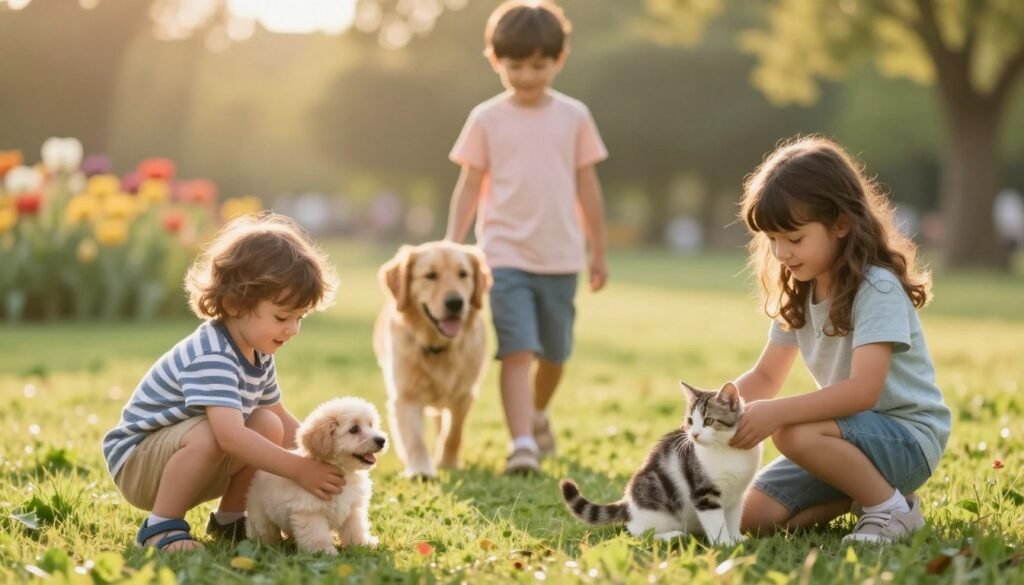
Preschoolers live in a magical world but are developing their coordination and impulse control. I recommend pets that can handle enthusiastic affection while showing their needs clearly.
Guinea pigs top my list for this age group. They’re sturdy and expressive, making them perfect for young children. A four-year-old will love their excited squeaking when you approach with vegetables.
Fish in a small aquarium are also great for preschoolers. They can help with feeding and see how their actions affect the fish. One family uses fish care as their daughter’s first daily responsibility.
I advise against hamsters for preschoolers, despite their popularity. Their nocturnal nature means less daytime interaction, and their small, fragile bodies are risky for this age. A well-meaning squeeze from an excited three-year-old can cause serious harm.
Key considerations for preschooler pets:
- Gentle temperament that tolerates learning mistakes
- Daytime activity patterns matching your child’s schedule
- Simple care routines requiring only 5-10 minutes daily
- Clear emotional expressions kids can recognize
- Durability without being completely unresponsive
Ideal Animal Companions for Elementary Kids Ages 6-10
Elementary school brings big changes. Kids can understand cause and effect, follow routines, and see things from others’ perspectives.
This makes elementary age perfect for pets that show the effects of care quality. Rabbits, cats, and small to medium dogs excel at teaching these lessons. A rabbit that hops excitedly toward a child who’s been gentle and consistent shows the rewards of good treatment. A cat that hides when handled roughly teaches boundaries in real-time.
I’ve seen children bonding with pets transform most noticeably with dogs during these years. A seven-year-old learning to read a dog’s body language—recognizing when Rover wants to play versus when he needs quiet—develops observation skills that transfer directly to reading human emotions.
Breed selection matters enormously here. I recommend calm, patient breeds like Golden Retrievers, Cavalier King Charles Spaniels, or Beagles for families seeking empathy development. High-energy breeds like Border Collies or Jack Russell Terriers can overwhelm children who are building confidence in pet care.
For families without yard space, cats offer incredible empathy-building opportunities. They’re more independent than dogs but form strong bonds. An eight-year-old who learns to respect a cat’s need for alone time practices social skills.
Elementary-age care opportunities:
- Morning feeding routines before school
- Grooming sessions that teach gentle touch
- Basic training exercises building communication skills
- Litter box or cage cleaning teaching consequence awareness
- Interactive play sessions requiring energy management
Perfect Empathy-Building Pets for Tweens and Teens Ages 11+
Teenagers crave meaningful responsibility that acknowledges their growing capabilities. The right pet gives them exactly that—a relationship requiring sophisticated care and emotional rewards.
Larger dogs needing consistent training challenge teens to develop leadership skills alongside empathy. I’ve seen formerly self-absorbed thirteen-year-olds blossom into patient, observant young people through training a rescue dog with behavioral challenges. The experience taught them that building trust takes time and consistency.
Horses represent the ultimate empathy-building opportunity for committed teens. The financial and time investment is substantial, but the emotional development I’ve witnessed in teens who care for horses is remarkable. They learn to read subtle body language, maintain routines despite competing priorities, and understand that their emotional state directly affects another being.
Surprisingly, reptiles also work wonderfully for this age when matched with the right teen personality. Bearded dragons, ball pythons, or tortoises require precise environmental control and research-based care. A scientifically-minded teenager who masters these requirements develops responsibility and nurturing behavior through intellectual engagement.
The key with teens is choosing pets that respect their growing independence while requiring genuine commitment. Children bonding with pets at this stage need animals that can’t simply be ignored when social lives get busy.
| Pet Type | Best Age Range | Daily Care Time | Primary Empathy Skills Developed |
|---|---|---|---|
| Guinea Pigs | 3-8 years | 15-20 minutes | Routine, gentle handling, emotion recognition |
| Fish | 3-10 years | 5-10 minutes | Observation, consistency, cause-effect understanding |
| Cats | 6-18 years | 20-30 minutes | Boundary respect, independence balance, mood reading |
| Small-Medium Dogs | 7-18 years | 45-60 minutes | Communication, training patience, active caregiving |
| Large Dogs | 11-18 years | 60-90 minutes | Leadership, consistency, complex relationship management |
The honest truth I share with every parent: the “right” pet depends less on the animal and more on your family’s lifestyle and your realistic assessment of who will actually provide daily care. A hamster requiring 10 minutes daily becomes a parent’s burden if that’s 10 minutes more than your schedule allows.
I encourage families to spend weeks researching before acquiring any pet. Visit friends who own the animals you’re considering. Volunteer at shelters where your child can interact with different species. Watch how your child responds to animals with varying energy levels and care needs.
The most successful children bonding with pets happens when expectations match reality from day one. That means choosing an animal whose temperament, care requirements, and interaction style genuinely fit your child’s current abilities—not the abilities you hope they’ll develop.
Step 1: Setting Up Your Home for Empathy-Focused Pet Ownership
Working with families, I’ve seen that the best pet journeys start weeks before the pet arrives. This preparation phase is key. Without it, even the best intentions can turn into stress.
This initial setup phase is where you teach responsibility and empathy in children. It’s like building a stage before the show. When you prepare well, you show your kids that caring for a pet is serious work.
In France, kids learn about animals as living beings that need care. This view makes pet care a part of moral education. I’ve seen this approach work well with families.
Evaluating Your Family’s Readiness for Pet Responsibilities
Before visiting shelters or breeders, do a family readiness check. This isn’t about being hard on yourself. It’s about making sure everyone is ready for the pet.
Ask important questions. Can your family handle daily care without feeling resentful? Can you afford unexpected vet bills? Does everyone really want a pet, or is someone being pushed?
I’ve made a checklist for families based on my experience. Use it to check your readiness:
| Readiness Factor | Questions to Consider | Red Flags | Green Lights |
|---|---|---|---|
| Time Commitment | Can we dedicate 30-60 minutes daily to pet care and interaction? | Overscheduled family calendar with no flexibility | Consistent daily routines with built-in home time |
| Financial Resources | Do we have emergency savings for veterinary care beyond routine costs? | Living paycheck-to-paycheck with no cushion | Stable income with discretionary budget for pet expenses |
| Living Situation | Does our housing allow pets, and do we plan to stay here long-term? | Rental restrictions or frequent moves expected | Pet-friendly stable housing for foreseeable future |
| Family Agreement | Is everyone genuinely enthusiastic, or are some members reluctant? | One parent strongly opposed or children showing lukewarm interest | Unanimous excitement with realistic expectations |
| Long-Term Commitment | Are we prepared for 10-20 years of care through life changes? | Treating pet as trial or temporary situation | Understanding this is a lifetime commitment |
Pets live for years, often longer than children’s interests change. A hamster for a seven-year-old needs care until they’re in middle school. A puppy adopted at ten will need walks when they’re applying to college.
This assessment helps everyone. It teaches children that big commitments need careful thought. This lesson builds empathy and responsibility, more than any daily task.
Having the Pre-Adoption Conversation About Compassion
After confirming your family’s readiness, have a meeting to discuss pet ownership. This conversation is key before bringing an animal home.
Talk about the animal’s needs, not what your kids will get. This shifts focus to what the pet needs from them. This approach plants seeds of responsibility and empathy before the pet arrives.
Here are conversation starters I’ve used with families:
- “What do you think our mornings will look like when we have a dog who needs to go outside before breakfast?”
- “How will we make sure our cat doesn’t feel lonely when everyone is at school and work all day?”
- “What should we do if you’re invited to a friend’s house on a day when it’s your turn to clean the cage?”
- “How would you feel if you were hungry but couldn’t open the refrigerator yourself and had to wait for someone to remember you?”
- “What happens to our pet’s trust in us if we’re too tired to play one evening, then the next, then the next?”
These questions show if children understand the need for consistency. They often imagine fun moments but not the daily chores.
Discuss animals as beings with feelings who depend on their human families. Not just when it’s convenient, but every day. This makes pet care a moral responsibility, not a hobby.
Ask children to predict challenges. “What will be the hardest part of having a rabbit?” or “When do you think you might not feel like doing your pet chores?” These questions build realistic expectations and show you value their participation.
Creating Physical Spaces That Encourage Nurturing Behavior
The physical environment you create shows how much you value pet care. Designing spaces that encourage nurturing behavior teaches children respect for animal needs.
Start with a pet care station at child height. Having supplies within reach lets children care for pets independently. This boosts their confidence and competence.
Include these elements in your pet care station setup:
- Food and water bowls in a consistent, easy-to-reach location
- Storage containers for food that children can open safely
- Grooming supplies (brushes, nail clippers) organized in a visible basket
- Cleaning supplies appropriate for the specific pet (cage cleaner, litter scoop, waste bags)
- A posted visual schedule showing daily care tasks and whose turn it is
Next, create a quiet safe space for your pet. This could be a crate for a dog, a cat tree, or a covered area for small animals. Teaching children to respect these spaces builds empathy through action.
The “Tender Paws” program emphasizes creating appropriate environments. These environments meet animal welfare needs and support children’s caregiving success. These goals work together beautifully.
Consider these spatial questions as you prepare your home:
- Is the feeding station accessible to small children without creating trip hazards?
- Can kids observe the pet during rest times without disturbing them?
- Is there comfortable space for child-and-pet interaction that works for both?
- Does the pet have retreat options when they need solitude?
- Are care supplies organized visibly so tasks don’t become hide-and-seek games?
Visual care schedules are important. A chart showing feeding times, cleaning, and play sessions makes tasks clear. This removes ambiguity and builds accountability.
I recommend creating schedules together as a family. When children help design the system, they feel more invested. This investment leads to better follow-through.
This setup work sends a strong message. It shows that pet care is important and organized family business. The environment you create reminds everyone that caring for another living being requires effort and attention every day.
The preparation phase might seem like extra work before the pet arrives. But it turns chaos into learning opportunities. It sets patterns that will help your family throughout the pet’s life and beyond.
Step 2: Designing Age-Appropriate Daily Care Routines
Building empathy through pet care is about daily routines, not big gestures. It makes caring for pets as natural as breathing. Children become kind by doing caring tasks every day.
Tasks like feeding the hamster before breakfast teach children to think of others first. This isn’t just teaching kindness—it’s changing their brain.
Daily routines are powerful because they repeat. France teaches care through familiar situations. A hungry pet is something kids can understand because they know hunger.
Morning Care Tasks That Build Awareness of Others’ Needs
Morning routines are great for teaching children to put others first. Before they grab their tablet or ask for breakfast, they can check on their pet.
Start with simple tasks that help kids develop caring behavior:
- Fresh water check: Young children can make sure the water bowl is clean and full before school
- Food portioning: Measuring food teaches precision and awareness of dietary needs
- Quick health observation: Looking for normal behavior patterns helps kids think critically
- Morning greeting ritual: A gentle pat or quiet hello helps build emotional connection
Make these tasks a must-do, like brushing teeth. When morning pet care becomes automatic, kids learn that relationships need daily effort.
Children who do morning pet care tasks arrive at school calm and focused. They feel accomplished and confident.
After-School Responsibilities That Develop Consistency
After-school routines help fight instant-gratification by requiring kids to care for pets first. This teaches that consistent care is more important than occasional big gestures.
These tasks teach kids that consistent care is key:
- Exercise and play sessions: Dogs need walks; cats need play; rabbits need supervised time
- Habitat maintenance: Spot-cleaning cages, refreshing bedding, or scooping litter boxes
- Training practice: Five minutes of commands or tricks strengthens communication skills
- Grooming basics: Brushing, nail checks, or tooth care depending on the pet type
After-school pet care is great because it helps kids burn off energy while practicing patience and gentle handling.
Pets thrive on routine. When kids provide consistent care, they see how it impacts the pet’s wellbeing and behavior.
Bedtime Routines That Reinforce Caring Habits
Evening care routines offer quiet, connected moments that become cherished memories. Tucking in a pet for the night mirrors the nurturing children receive from parents.
Bedtime tasks focus on comfort and security:
- Final feeding check: Ensuring no one goes to bed hungry
- Comfort preparations: Fluffing bedding, positioning favorite toys, adjusting temperature
- Safety verification: Checking cage latches, closing doors, removing hazards
- Goodnight ritual: Gentle petting, soft words, or simply sitting quietly together
These gentle nighttime interactions teach children that caregiving isn’t just about physical needs. Emotional comfort matters too. When kids tuck in their guinea pig with tenderness, they’re practicing perspective-taking in its purest form.
Children who struggle with anxiety find peace in these bedtime pet rituals. Caring for another living being gives them purpose and calm that helps them sleep better.
Sample Weekly Care Schedule by Age Group
Every child develops at their own pace. These guidelines offer a starting point for assigning tasks. The goal is to build responsibility and empathy in children through daily tasks.
| Age Group | Morning Tasks | After-School Tasks | Evening Tasks | Weekly Deep-Clean |
|---|---|---|---|---|
| Ages 3-5 | Help fill water bowl with supervision, gentle morning petting | Supervised play session, help scatter food | Help with bedtime comfort items, goodnight pets | Watch and hand items to parent during cleaning |
| Ages 6-8 | Complete feeding independently, fresh water, basic observation | 15-minute play or walk with nearby adult, spot-clean habitat | Full evening feeding, bedding check, safety verification | Clean small cages or litter boxes with minimal supervision |
| Ages 9-11 | All feeding, water, health checks, morning exercise for small pets | Independent dog walks (size-appropriate), grooming sessions, training practice | Complete evening routine, comfort preparations, next-day supply check | Full habitat deep-clean, supply inventory, identify needed items |
| Ages 12+ | Complete independent morning routine, adjust for pet’s changing needs | Extended exercise, enrichment activities, problem-solve disruptions | Full care plus preparation for next day, identify health concerns | Total responsibility including scheduling vet appointments and researching care improvements |
Remember, these are starting points, not strict rules. Some seven-year-olds might be ready for tasks meant for nine-year-olds. The key is daily engagement that makes caring for pets as essential as personal hygiene.
Always start smaller than you think necessary. Success builds on success. A child who confidently completes simple tasks will naturally ask for more responsibility as they grow.
What matters most is that these daily routines become the foundation for lifelong compassion. When children consistently meet another being’s needs, they develop habits that help in human relationships. They learn that love is showing up every day, whether they feel like it or not.
Step 3: Teaching Your Child to Recognize and Respond to Animal Emotions
Watching children grow from just doing pet chores to truly understanding their pets is amazing. It starts with learning to read animal signals. This step goes beyond just feeding and cleaning up. It’s about understanding what makes pet care so powerful for developing kindness through animal care.
Animals talk to us all the time through body language, facial expressions, and sounds. But most of us miss these signals. Teaching your child to notice these signs helps them develop emotional intelligence that goes beyond animals.
Reading Body Language: What Your Pet Is Really Communicating
Every little thing about a pet’s body tells a story. I start by showing kids that animals have their own way of speaking. Learning this is like becoming bilingual in emotions. France’s education system even teaches kids that animals feel stress, pain, and comfort, and our actions affect them.
For dogs, the signals are clear once you know what to look for:
- Relaxed and happy: Soft eyes, loose body, wide tail wag, open mouth “smile”
- Anxious or stressed: Whale eye, tucked tail, too much panting, yawning, lip licking
- Fearful: Cowering, tail tucked, ears back, trembling
- Alert or cautious: Stiff body, high and steady tail, focused stare, raised hackles
- Playful: Play bow, bouncy, open mouth, quick movements
Cats also communicate clearly. I teach kids to watch for slow blinks, which are like cat kisses. A cat with flat ears and a lashing tail means “back off.” Purring usually means they’re happy, but some cats purr when stressed too, so context is key.
For small animals like guinea pigs, rabbits, or hamsters, the signals are subtle but important. Guinea pigs “wheek” excitedly, while teeth chattering means annoyance. Rabbits do “binkies” when happy, but thump their legs when scared.
Practicing Active Observation Skills
Reading about body language is one thing. Noticing it in real life is another skill. This is where developing kindness through animal care becomes a daily practice.
I suggest starting with simple observation prompts. Ask your child to notice what their pet is doing before feeding. Ask them how the pet is feeling and what tells them that. These questions help children become more mindful.
One activity that works well is the daily observation journal. Even young children can draw simple pictures of their pet with labels like “happy,” “sleepy,” or “wanted to play.” Older kids can write short notes: “Whiskers hid under the bed when my friends came over—I think the noise scared her.”
This practice helps children focus on the present moment. It teaches them that relationships need attention and presence. When a child notices their rabbit’s rapid breathing when held too tightly, they’re learning to notice non-verbal cues that help them understand human emotions too.
Set aside “observation time” a few times a week. Have your child watch their pet for five minutes without interacting. Ask them to report what they noticed. This exercise strengthens attention and empathy skills.
Role-Playing Scenarios to Build Perspective-Taking
Cognitive empathy can be taught through role-playing. I use these exercises because they make abstract concepts real and memorable.
Try these scenarios with your child:
- “You’re the hamster” exercise: Have your child pretend they’ve been in a small cage all day. Ask them to show you how they’d feel when someone takes them out. This helps them understand enrichment needs.
- “Fireworks feelings” role-play: Ask your child to imagine being the dog during fireworks. What would they need from their family? Where would they want to go? This connects to comfort-seeking behavior.
- “New person visiting” scenario: Have your child be the cat when strangers come over. Do they want to be grabbed and petted, or would they prefer to approach on their own terms? This teaches respect for boundaries.
- “Sick day” perspective: Ask your child to imagine being the pet when they’re not feeling well but can’t tell anyone. How would they try to communicate? This builds diagnostic observation skills.
These activities do more than entertain. They literally change how children think about others’ inner lives. The Tender Paws program shows that understanding animal behavior helps children develop empathy for humans too.
Warning Signs Your Child Should Learn to Identify
Safety and empathy go together. Teaching children to recognize warning signs is not about creating fear. It’s about respecting the animal’s communication. When a pet signals discomfort or distress, ignoring those signals goes against everything we’re teaching.
Children should learn to stop immediately when they see:
- Growling, hissing, or showing teeth
- Ears pinned completely back against the head
- Hair standing up (raised hackles on dogs, puffed tail on cats)
- Sudden freezing or stiffening of the entire body
- Persistent attempts to hide or retreat
- Snapping or lunging movements
- Whale eye with a stiff, turned-away body
Frame these warning signs positively. Explain that these signals mean your pet needs space right now. Giving them space shows you respect their feelings—that’s what empathy really means. This teaches children that kindness sometimes means backing away.
I always explain that animals, like humans, have bad days, feel unwell, or just need alone time. Recognizing and honoring these needs shows advanced emotional intelligence. It’s also a key lesson: not everyone wants interaction all the time, and respecting that is caring.
When children master these skills with their pets, you’ll see something amazing. They start noticing when someone’s smile doesn’t match their eyes, when a friend’s posture shows they’re upset, or when someone needs space. This is the beautiful effect of developing kindness through animal care—it creates emotionally intelligent humans who see beyond surfaces to the feelings underneath.
Step 4: Using Guided Conversations to Deepen Empathetic Understanding
After years of watching families with pets, I noticed a pattern. The deepest emotional growth happened in homes where parents asked curious questions about their animals. It wasn’t the type of pet or the care routines that mattered. It was the intentional dialogue that turned routine tasks into learning moments.
Daily feeding and cleaning cages build responsibility. But they don’t automatically create empathy. What changed for the families I worked with was adding reflective conversations to these tasks. France’s approach to animal care shows this beautifully—treating pets as individuals to understand.
The “Tender Paws” philosophy focuses on attunement and recognizing each animal’s unique personality. When we guide children to think deeply about their pets’ experiences, we’re developing their capacity for perspective-taking. This skill is the foundation for teaching children empathy through pets, extending beyond the home.
Questions That Help Kids Think Like Their Pets
I’ve found that simple, well-timed questions work like magic. These aren’t random inquiries—they’re exercises in Theory of Mind, helping children recognize that others have thoughts and feelings different from their own.
The key is matching question complexity to your child’s developmental stage. Younger children need concrete, observable prompts while older kids can handle abstract thinking.
| Age Group | Question Type | Example Questions | Cognitive Skill Developed |
|---|---|---|---|
| Ages 3-5 | Concrete Observations | “Is Fluffy happy or sad right now? How can you tell?” | Emotional recognition |
| Ages 6-8 | Cause and Effect | “Why do you think our dog hides during thunderstorms?” | Understanding motivations |
| Ages 9-12 | Abstract Thinking | “If you were a fish, what would make your day interesting?” | Perspective-taking |
| Ages 13+ | Complex Preferences | “Do you think our cat prefers alone time or family time? What evidence supports that?” | Analysis and reasoning |
I love weaving these questions into natural moments. While pouring kibble, I might ask, “How do you think Buddy feels when we all leave for the day?” During bedtime routines, “What do you imagine Whiskers dreams about?” These brief conversations create powerful learning without feeling like lessons.
Connecting Animal Feelings to Human Emotions
This is where the real transformation happens. When children learn to identify emotions in their pets, we need to help them build bridges to human experiences. That’s the secret to helping kids develop empathy that extends beyond animal care.
I encourage comparison conversations that make these connections explicit. After a vet visit, I might say, “Remember how scared our cat was at the vet? Have you ever felt that nervous about something? What helped you feel better?” This creates emotional parallel thinking.
Another favorite approach involves joy recognition. “Our dog gets so excited when we come home—who in your life makes you feel that happy to see them?” These questions activate the same neural pathways children use when navigating friendships and family relationships.
The beauty of this method is its simplicity. You don’t need special training or complicated curriculum. Just consistent, thoughtful questions that honor both the animal’s experience and your child’s expanding emotional awareness.
Journaling and Reflection Activities for Older Children
For children ages seven and up, written reflection adds another powerful dimension. I’ve watched journaling transform how kids process their pet care experiences and deepen their emotional intelligence.
Start with simple weekly prompts that encourage observation and metacognition:
- “What did I learn about my pet’s personality this week?”
- “When did I notice my pet having a strong feeling? What caused it?”
- “How did I help my pet feel safe, happy, or comfortable today?”
- “What surprised me about how my pet reacted to something?”
Creative children might prefer drawing their pet’s emotions or writing from the animal’s point of view. One ten-year-old I worked with wrote beautiful “diary entries” as her rabbit, exploring what the world looked like from that perspective. Her mother told me this activity dramatically improved her daughter’s ability to consider other viewpoints during conflicts with siblings.
These reflection activities don’t need to be lengthy or formal. Even three sentences at bedtime or a quick sketch before school creates meaningful processing time. The consistency matters more than the duration.
What I appreciate most about these guided conversations and reflections is their flexibility. Whether you have two minutes while filling a water bowl or ten minutes during a quiet evening, you’re creating opportunities for emotional growth. The practices adapt to your family’s rhythm while consistently reinforcing the compassionate awareness at the heart of empathy development.
How These Lessons Naturally Transfer to Human Relationships
Watching children care for animals is amazing. They start treating people better too. The skills they learn from pets help them in all kinds of relationships.
Studies show that kids who care for animals are better at getting along with others. They’re more patient and less likely to fight. This is because they learn to understand and respond to others’ feelings.
Empathy is a skill that can be used in many ways. Once kids learn to notice and respond to animal needs, they can do the same with people. This makes them better friends and family members.
From Pet Care to Playground: Real-World Empathy Applications
Let me share some examples of how pet care helps kids in real life. These moments show how caring for animals can make a big difference in their social world.
I saw a girl who understood her dog’s anxiety. She noticed a shy classmate and helped them feel better. At a loud party, she noticed a quiet boy and suggested they take a break.
A boy who feeds his rabbit every day noticed when his sister needed water. He helped her without being asked. This shows how caring for animals can help in other relationships too.
A girl who was gentle with her guinea pig was also kind to her crying friend. She used the same gentle touch and understanding with her friend as she did with her pet.
These aren’t just one-time events. Kids who care for animals learn to be empathetic in all their relationships. Their brains don’t see a difference between caring for animals and people.
Social Skills I’ve Watched Blossom Through Animal Responsibility
Children who care for animals develop important social skills. These skills are essential for getting along with others.
Here are some key social skills that kids develop through pet care:
- Active listening skills: By paying attention to animals, kids learn to listen better to people too.
- Patience development: Waiting for animals to be ready teaches kids that relationships take time.
- Conflict resolution abilities: When pets don’t behave, kids learn to find solutions without forcing things.
- Boundary respect: Animals teach kids to respect others’ space, a key skill for healthy relationships.
- Anticipating needs: Preparing for pets’ needs helps kids think ahead in all their relationships.
- Delayed gratification: Daily tasks that aren’t immediate rewards teach kids to invest in relationships.
- Gentleness and touch regulation: Learning to handle pets gently helps kids understand how to interact with others.
These skills are developed through daily pet care. They become second nature, helping kids in all their social interactions.
| Pet Care Practice | Social Skill Developed | Real-World Application |
|---|---|---|
| Reading animal body language (tail position, ear placement, posture) | Non-verbal communication interpretation | Recognizing when classmates feel uncomfortable, anxious, or upset based on facial expressions and body posture |
| Adjusting approach when pet is scared or resistant | Flexibility and adaptive thinking | Changing tactics during disagreements with friends instead of insisting on one approach |
| Maintaining feeding schedules regardless of mood | Reliability and commitment | Following through on promises to friends and keeping commitments even when inconvenient |
| Staying calm during training setbacks | Emotional regulation and patience | Managing frustration during group projects or when learning doesn’t happen immediately |
| Respecting when animals signal they want space | Boundary recognition | Understanding when peers need alone time without taking it personally |
Building Emotional Regulation Through Daily Animal Interactions
One of the best things about pet ownership is how it helps kids manage their emotions. This is a skill that many parenting methods miss.
When training doesn’t go well, kids might get frustrated. But yelling or showing anger can scare the animal. This teaches kids to manage their feelings in a healthy way.
When a pet wants to be alone, kids learn to respect that. This teaches them to accept that others’ needs might be different from their own. This is a sophisticated skill that helps prevent conflicts.
When a pet gets sick, kids feel worried. But they learn to channel that worry into caring for the pet. This shows that emotions can motivate us to help others, not just cause problems.
Animals provide a safe space for kids to practice managing their emotions. Unlike people, animals don’t judge or tease. They simply respond to the energy kids bring.
Studies back up these observations. Kids with pets are better at handling stress and have stronger emotional skills. The calmness they feel from petting animals, combined with daily practice, helps them manage their emotions.
These skills don’t just help with pets. They help kids deal with the ups and downs of human relationships too. A child who stays calm when their rabbit is scared can also handle tough situations with friends.
Children who care for pets show better emotional control, understanding, and kindness to others. This is true whether they’re with friends or family.
Every moment spent caring for an animal helps kids build better relationships with people. The patience, understanding, and emotional control they practice with pets are the same skills they use to make friends, solve problems, and navigate the world of childhood and beyond.
Navigating the Tough Moments That Actually Strengthen Empathy
Watching families with pets has taught me a lot. The tough times teach more about empathy than the easy moments. When your child forgets to feed the guinea pig or your son gets upset about a sick hamster, these are chances for emotional growth.
The bond between pets and childhood emotional development grows strongest in hard times, not just when things go well. These moments teach kids that caring for others means being consistent, that living beings can suffer, and that commitment lasts even when enthusiasm wanes.
France’s national action plan knows this truth. Every year, thousands of animals end up in shelters because families didn’t realize caring for pets is a big commitment. Teaching kids early that animals need consistent care helps prevent pets from being abandoned later.
When Enthusiasm Fades: Maintaining Commitment Through the Boring Parts
Remember when your child begged for a puppy? They promised to walk him every day, rain or shine. But after a few months, those walks became your job.
This happens in many homes with pets. I’ve seen it many times. The key is not to take over for your child.
Instead, try these strategies to keep your child accountable while acknowledging their tiredness:
- Break tasks into smaller chunks – Instead of “clean the entire cage,” start with “change the water bottle”
- Create visual reminder systems – Colorful checklists or phone alarms that transfer responsibility without nagging
- Connect privileges to completion – “You can play video games after the hamster cage is clean” teaches cause and effect
- Have matter-of-fact conversations – “I know feeding the fish isn’t exciting anymore, but he depends on you every single day—that’s what commitment means”
These moments teach a vital empathy lesson: caring for others means showing up even when you don’t feel like it. This mirrors the unconditional care parents give their children, creating a powerful parallel.
The “Tender Paws” program helps families through these tough times. They know that staying committed during dull moments builds character that goes beyond pet care.
Transforming Pet Illness Into Compassion Lessons
When your rabbit stops eating or your cat needs surgery, you might want to shield your child from worry. I get that instinct completely.
But pet illness offers a unique chance to learn empathy. These times teach compassion during vulnerability, one of life’s most important skills.
Guide your child through vet visits and recovery care in ways they can understand:
| Age Group | Appropriate Involvement | Empathy Skills Developed |
|---|---|---|
| Ages 3-5 | Sitting quietly near recovering pet, gentle petting, bringing water | Recognizing when others need calm, adjusting behavior |
| Ages 6-10 | Helping administer medication, creating comfort spaces, monitoring symptoms | Active caregiving, responsibility during crisis, observation skills |
| Ages 11+ | Researching the illness, tracking treatment progress, making care decisions with parents | Problem-solving, medical empathy, collaborative decision-making |
Ask questions that build nurturing instincts: “How do you think Fluffy feels when she’s sick?” and “What can we do to make her more comfortable?” These simple conversations help develop perspective-taking that applies to human relationships.
I’ve seen children become incredibly attentive caregivers during pet illness. They notice subtle changes in behavior, adjust their own energy levels, and show genuine concern—all key components of emotional intelligence.
Handling Loss With Emotional Honesty and Grace
Pet loss is one of the hardest parts of pet ownership, but it’s also a valuable lesson. The grief children feel when a beloved animal dies helps them develop emotional literacy in ways few other experiences can.
I strongly believe in being emotionally honest with children. Telling them the dog “went to sleep” or “went to a farm” can confuse and worry them about sleep or separation.
Instead, explain death in terms they can understand and give them space to grieve:
- For younger children: “Buddy’s body stopped working, and he died. That means we won’t see him anymore, but we can remember all the fun times we had together.”
- For older children: More detailed explanations about illness, age, or accidents, always stressing it’s not their fault
- For all ages: Permission to feel sad, cry, and talk about their feelings as much as needed
Create meaningful ways to honor your pet’s memory while processing loss. Make a photo album together, plant a memorial garden, write goodbye letters, or share favorite memories at dinner.
Programs like “Tender Paws” support families through these transitions. They know that grieving is a natural response to loss. They help parents understand that experiencing and expressing grief in the safe context of pet loss prepares children for future human losses with healthier coping mechanisms.
The emotional skills children develop while mourning a pet—naming feelings, seeking comfort, remembering positive experiences—become lifelong tools for navigating loss and supporting others through their grief.
Turning Sibling Conflicts Into Fairness Lessons
If you have multiple children and one pet, you’ve probably had to referee arguments about whose turn it is to walk the dog or who gets to hold the rabbit. These conflicts might seem like annoying distractions, but they’re actually chances to practice fairness and work together to solve problems.
I’ve found that sibling disagreements over pet responsibilities teach empathy-adjacent skills like negotiation, expressing feelings respectfully, and considering others’ perspectives.
When conflicts arise, try holding family meetings to fairly distribute tasks. Teach children to express frustrations in a constructive way: “I feel upset when I do all the hard jobs” instead of “You never help!”
Then guide them toward finding solutions together:
Why might your brother be avoiding the litter box? Could we solve that problem together? Maybe he finds the smell overwhelming. What if we moved it to a better-ventilated area, or he wears a mask while cleaning it?
This approach teaches children that problems have solutions and that understanding someone’s perspective doesn’t mean excusing them from responsibility. Both lessons are invaluable in adult relationships.
Create a rotating schedule that ensures fairness, or let children choose tasks based on their preferences while ensuring equal effort. One child might prefer feeding while another enjoys walking—honoring individual differences while maintaining equity.
These challenging moments, when handled thoughtfully, actually accelerate development. They provide authentic, emotionally significant practice in considering others’ needs alongside our own—the very foundation of empathy that extends far beyond pets and childhood emotional development into every future relationship your child will have.
Recognizing the Signs Your Child Is Developing Deeper Empathy
Watching your child grow in empathy is incredibly rewarding. After weeks or months of teaching kids learning compassion from animals, you’ll see signs of growth. These signs show when your child is truly understanding others.
Empathy grows differently at each age. What’s important is the overall growth in understanding others’ needs and feelings.
France’s educators teach respect early, which helps with responsibility at all ages. This is true for teaching empathy through pets too. Consistent effort leads to meaningful growth.
Observable Shifts in Daily Interactions
Look for small, everyday changes in your child’s behavior. These changes show they’re learning to be compassionate without being told.
When nurturing behavior in kids with pets becomes automatic, it’s a sign of real growth. I recall a parent telling me how her seven-year-old started checking on their rabbit before playtime, ensuring it had fresh water.
Watch for these signs of deepening empathy:
- Unprompted checks on the pet’s wellbeing
- Gentler physical interactions
- Advocating for the pet’s needs
- Considering the pet in family plans
- Showing concern when the pet seems unwell
- Defending the pet against teasing
- Adjusting behavior based on the pet’s mood
You’ll also see broader changes in how your child interacts with people. These changes show the lessons are spreading beyond just pet care.
Common signs include:
- Increased patience with younger siblings or classmates
- Noticing when friends or family members seem upset
- Offering help without being asked
- Showing concern for characters in stories
- Expressing care for people outside their circle
- Asking thoughtful questions about others’ experiences
The “Tender Paws” framework helps parents see these changes. It teaches patience, attunement, and emotional safety. This approach reminds parents to celebrate progress without expecting too much too soon.
| Age Group | Early Empathy Signs | Developing Empathy Signs | Advanced Empathy Signs |
|---|---|---|---|
| Preschool (3-5) | Gentle touching when reminded | Checking if pet has food/water | Comforting pet during storms without prompting |
| Elementary (6-10) | Following care routines consistently | Noticing when pet seems sad or tired | Adjusting play style based on pet’s energy |
| Tweens/Teens (11+) | Taking initiative with daily tasks | Researching better care methods independently | Advocating for pet’s needs in family decisions |
Language That Reveals Internal Perspective-Taking
Spontaneous language is a strong indicator of empathy. These conversation cues show your child is thinking about others’ feelings.
I’ve collected many examples from families. Certain phrases show genuine perspective-taking skills. Listen for statements that show your child is thinking about another being’s internal experience.
Powerful empathy phrases include:
- “I think Bella is hiding because she needs quiet time” (recognizing another’s need differs from their own desire to play)
- “That would make me sad too if I were the bunny” (connecting others’ experiences to their own emotions)
- “We should ask the dog instead of deciding for him” (recognizing another being’s agency)
- “I wonder what she’s thinking about” (curiosity about others’ internal experiences)
- “He probably doesn’t like loud noises because they hurt his ears” (making logical inferences about others’ discomfort)
- “Maybe the cat is grumpy because she didn’t sleep well” (attributing behavior to underlying causes)
These spontaneous comments show cognitive empathy. When combined with caring actions, they indicate that kids learning compassion from animals are developing the full empathy spectrum.
Older children might express more sophisticated perspective-taking through questions or observations. A ten-year-old might say, “Do you think our hamster gets bored when we’re at school all day?” This shows abstract thinking about another being’s subjective experience over time.
Notice how your child talks about conflicts or challenges involving the pet. Statements like “I know I want to play, but he looks tired” show they’re balancing their own desires against another’s needs. This is a sophisticated emotional skill that transfers to human relationships.
Validation From the Wider World
Sometimes, the most convincing evidence of empathy development comes from outside your home. Teachers, coaches, and other parents often notice changes in your child’s social behavior before you fully recognize the transformation happening under your own roof.
I encourage parents to pay attention to feedback from educators and other adults in their child’s life. These outside observations provide powerful confirmation that nurturing behavior in kids with pets is generalizing to broader social contexts.
Common feedback parents receive includes:
- “Your child has become so helpful with classmates who are struggling”
- “She’s really patient with the younger players now”
- “He was the first to notice when a new student seemed left out”
- “Your daughter showed exceptional kindness when her friend was upset”
- “I’ve noticed he’s much more considerate during group activities”
Teachers notice shifts in classroom dynamics. A child who has developed empathy through pet care often becomes a natural mediator during conflicts or voluntarily helps peers who are having difficulty.
When you receive this type of feedback, share it with your child. Connect their expanding compassion directly to the work they’ve been doing with your family pet. You might say, “Your teacher told me you were really kind to Emma today. I think learning to understand what Buddy needs has helped you notice when other people need kindness too.”
This reinforcement helps children recognize that the patient, attentive skills they practice with animals apply equally to human relationships. It validates their efforts and strengthens the connection between their pet-care responsibilities and their growing capacity for compassion.
I want to remind you that empathy development isn’t linear. Your child will have setbacks, selfish moments, and days when they seem to forget everything they’ve learned. That’s completely normal and doesn’t erase the genuine progress they’re making.
What matters is the overall trajectory over months and years. When you notice several of these signs accumulating, you can feel confident that the foundation you’re building through pet care is creating lasting emotional growth in your child.
Conclusion
I’ve seen many families learn about empathy through pet care. It’s not about being perfect. It’s about the everyday effort of caring for another creature.
France has made empathy a key part of their education. They know that being aware is more important than being perfect. Your child might forget to refill the water bowl or skip a walk. But it’s in these moments that they learn.
Getting a pet is a big step. It takes time, money, and patience. But for families willing to make the effort, it’s a great investment in their children’s growth. Kids learn that their actions impact others and that love means being there even when it’s hard.
These lessons spread far. A child who notices their dog’s anxiety becomes a friend who looks out for others. A teenager who cares for a cat develops skills that last a lifetime.
Your pet helps you raise children who care about others. Together, you’re building a world where people notice and respond to suffering. This is done one feeding, one touch, one connection at a time.
If you’re ready, start this journey. If you already have pets, look at them with new eyes. They’ve been teaching you about empathy all along.
FAQ
At what age can children start learning empathy through pet care?
Kids as young as 2-3 can start learning empathy with pets. They might show concern when a pet seems upset. But, they don’t fully understand why. By age 4-5, kids start to see that animals have feelings too. By age 6-8, they can predict how their actions affect pets. Each age builds on the last, creating a strong foundation for compassion.
How long does it typically take to see empathy improvements in children after getting a pet?
Parents often see changes in 3-6 months with regular pet care. But, it depends on the child’s age and how you approach it. Early signs include gentler interactions and checking on pets. But, real empathy takes 1-2 years of daily care and conversations.
What if my child has special needs or developmental delays—can pet care help?
Yes, pet care can be very helpful for kids with special needs. Animals provide non-judgmental friendship and clear feedback. Adapt your approach to your child’s needs. For sensory sensitivities, choose calm pets. For executive function challenges, use visual schedules.
Children with emotional challenges often benefit from petting animals. This releases oxytocin, calming them down. The routines of pet care also help reduce anxiety.
Do certain types of pets teach empathy better than others?
Mammals with expressive faces, like dogs and cats, are best for teaching empathy. They show clear emotions, making it easier for kids to understand. The best pet depends on your family’s commitment. Even fish can teach empathy by showing subtle changes in behavior.
What if I’m allergic to common pets like cats and dogs—are there empathy-building alternatives?
Yes, many pets can teach empathy, even if you’re allergic. Rabbits, guinea pigs, birds, and fish are good options. Guinea pigs are hypoallergenic and social. They show emotions clearly, making them great for teaching empathy.
How do I handle situations where my child is too rough with our pet despite empathy lessons?
Rough handling is a normal challenge, not a failure of empathy. Start by calmly saying, “Gentle hands with Fluffy.” Address the underlying cause, like overstimulation. Practice reading pet body language and fine motor skills with stuffed animals. Role-playing can help. Have your child pretend to be the pet and see how it feels. This teaches empathy through real-world experiences.
Can pet care replace other empathy-building activities, or should it be combined with other approaches?
Pet care is powerful but should be part of a broader approach. It provides hands-on experience that abstract lessons can’t match. Combining pet care with other strategies creates a stronger effect. Reading books, volunteering, and modeling empathy all reinforce what pets teach.
What if my child loses interest in pet care after the initial excitement wears off?
Losing interest is normal and teaches a valuable lesson. Acknowledge their feelings and explain why caring for pets is important. Break tasks into smaller steps and create reminders. Connect responsibilities to privileges in a matter-of-fact way. Involve your child in problem-solving. This builds their ability to handle challenges and develops empathy.
How do I tell if my child is developing genuine empathy versus just following rules to avoid punishment?
Genuine empathy involves concern for others, not just avoiding punishment. Watch for signs like checking on pets without being told. They should advocate for pets’ needs and show emotional responses to their feelings. This shows they’re truly empathetic.
Can teaching children empathy through pets backfire if the pet displays aggressive or unpredictable behavior?
Aggressive or unpredictable pets can undermine empathy and pose risks. If your pet is concerning, seek professional help immediately. With proper intervention, pets can be safe companions. But, if the pet is too risky, rehoming might be the best choice. Teach children to respect pets’ boundaries and recognize normal behavior as communication, not aggression.
How do I balance pet-care responsibilities between multiple children without creating rivalry or resentment?
Create a fair care schedule with your family before getting a pet. Consider each child’s age and abilities. Rotate tasks to avoid favoritism. Assign specific responsibilities based on strengths and interests. Use family meetings to solve problems and maintain fairness.
What’s the connection between childhood pet care and adult compassion—does the research show lasting effects?
Research shows that childhood pet care can lead to higher empathy and prosocial behavior in adults. It creates lasting neural pathways. But, the quality of the experience matters. Children who had pets but no responsibility don’t show the same benefits. Intentional parental guidance is key.
Are there cultural or family situations where pet ownership for empathy-building might not be appropriate or effective?
Yes, pet ownership might not be right for all families. Respect cultural beliefs and financial realities. Consider alternatives like fostering or volunteering at animal shelters. Even small steps can be beneficial.
How can single parents or busy working parents realistically implement empathy-focused pet care when time is already stretched thin?
Pet care doesn’t need to take hours. Use the time you already spend together. Choose a pet that fits your schedule.
Build pet care into routines like feeding or walking. Use commute time for conversations about the pet. This makes empathy-building easy and natural.
What if my child witnessed or experienced trauma involving an animal—can pet care teach empathy in this situation?
Assess your child’s readiness with a mental health professional. Positive animal interactions can be healing for some. But, forcing interaction can retraumatize others. Start with small, controlled exposures. Celebrate small brave steps. Healing from trauma is itself an empathy-building process. It teaches recognizing and honoring your own needs and boundaries.
How does pet care teach children about responsibility alongside empathy, and which matters more for their development?
Responsibility and empathy are intertwined. Pet care teaches both through daily needs and emotional connection. Children learn that their actions have consequences for pets. This transforms task completion into caring behavior. Both are essential for raising compassionate children.