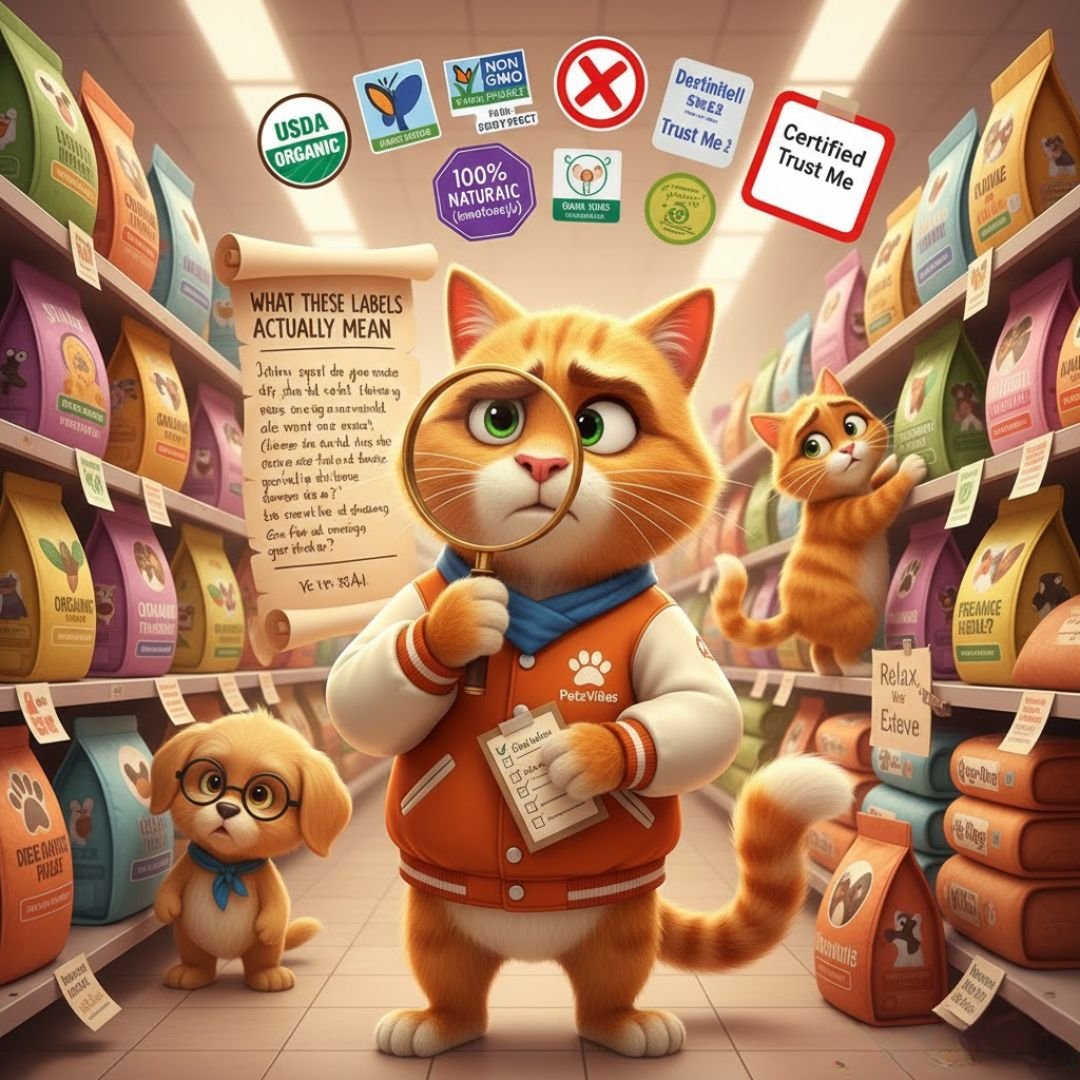
Ever stood in the pet food aisle, looking at all the labels? Wondered which ones really keep your pet safe?
I was in your shoes a few years back. I was lost in a sea of marketing terms. Words like “natural” and “human-grade” seemed important, but I didn’t know what they meant.
So, I started digging deeper. I learned about AAFCO, USDA, and FDA, and third-party certifiers. What I found was surprising—many claims aren’t checked by law.
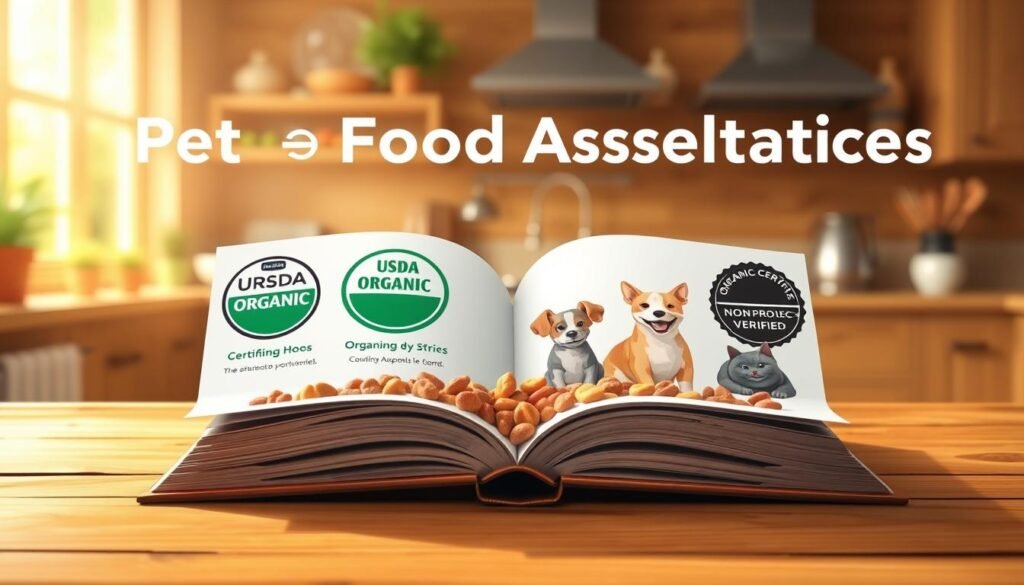
The Canadian Food Inspection Agency and vets say labels must tell us something. But, marketing terms can make it hard to tell real certified pet food labels from just ads.
In this guide, I’ll share what I’ve learned. It’s not just about feeling good. It’s about making sure your pet gets the best food from honest sources.
Key Takeaways
- Many pet food marketing terms like “natural” and “grain-free” lack official regulatory definitions
- USDA organic certification represents the most stringent government-backed standard for ingredient sourcing
- Third-party certifiers provide additional verification beyond minimum legal requirements
- Reading beyond front-of-package claims helps identify genuine quality assurance protocols
- Understanding regulatory bodies like AAFCO and FDA clarifies what protections exist for consumers
- Verified seals from recognized organizations offer more accountability than unregulated marketing language
🐾 Why I Started Paying Attention to Pet Food Certifications
For years, I made a big mistake with my pet’s food. I picked based on looks and sales, not what was inside. I didn’t think about how different foods could affect my pet’s health.
I thought all pet foods were the same because they were sold in good stores. This made me miss the link between food and my pet’s health.
Looking back, I didn’t know much about holistic pet nutrition. Becoming a better pet parent took time and effort. But it changed how I care for my pet.
My Journey to Understanding What My Pet Actually Eats
Going to the pet store used to confuse me. There were so many bags with different claims. Some had certifications I didn’t recognize.
I made choices based on what seemed right at the time. This included price, looks, flavor, brand names, and store advice.
- Price point that fit my budget
- Attractive packaging design
- Flavor variety my pet might enjoy
- Brand names I’d heard advertised
- Recommendations from store employees
I didn’t think about pet food ingredient quality. I didn’t know if the protein was good meat or by-products. I didn’t get how important daily nutrition was for pet health foundation.
I looked at ingredient lists but didn’t understand them. Terms like “crude protein” and “ash content” were unknown to me. I trusted the marketing and thought regulations protected us.
I picked my pet’s food carelessly, like I did with my own food. This realization was hard to accept.
The Wake-Up Call That Changed Everything
My vet visit changed everything. My pet had health issues and low energy. The vet asked what I was feeding.
I named the brand confidently. Then she asked more questions I couldn’t answer. She wanted to know about the protein source, organic status, and quality standards.
I felt embarrassed and frustrated. I fed my pet the same food every day, but I didn’t know its quality. That conversation was my wake-up call.
Good nutrition is the foundation of a pet’s long-term health, affecting everything from immune function to lifespan.
I left that appointment determined to learn. I researched regulatory bodies and certification standards. I learned about the big difference between marketing terms and real certifications.
The more I learned, the more I saw how little oversight there is in pet food. Understanding organic pet food certifications explained became key for making good choices.
I found that holistic pet nutrition is more than just listing ingredients. It’s about sourcing, manufacturing, quality control, and nutritional profiles. I wanted to provide a strong pet health foundation and demand real transparency.
This journey changed my approach to pet care. Now, I read labels carefully, research certifications, and ask manufacturers questions. My pet’s health improvement made every hour of learning worth it.
🏅 USDA Organic Certification: The Gold Standard for Pet Food
I once held two pet food bags side by side, one with a USDA Organic seal and one without. I wondered what that green circle meant for my dog. This moment sparked my interest in understanding usda organic pet food standards.
The USDA Organic certification is more than just a label. It’s the highest and most regulated standard in pet food. Seeing that seal means I know what it guarantees for my pets.
What USDA Organic Pet Food Certification Really Guarantees
The USDA Organic seal on pet food means it meets strict organic human food standards. This knowledge helped me trust that pet products have the same rules as human food. It ensures my pets’ health is protected.
Organic ingredients must be grown without harmful chemicals. Certified organic dog food comes from farms checked and verified every year. These inspections are required to keep the certification.
Animal-based ingredients in organic pet food come from animals raised without antibiotics or growth hormones. These animals must have outdoor access and eat organic feed. This standard ensures both ingredient quality and animal welfare.
Genetically modified organisms (GMOs) are not allowed in organic products. When I buy usda organic pet food, I know common ingredients like corn and soy aren’t genetically engineered. This gives me peace of mind about what my pets eat.
Organic ingredients can’t be irradiated, a preservation method used in some conventional pet foods. The USDA also bans most synthetic additives and processing aids. Only certain substances on the National List can be used.
Every producer must work with a USDA-accredited certifying agent for annual inspections. These agents ensure farms and manufacturers follow organic standards. This oversight system reassures me of continuous monitoring, not just one-time certification.
The Three Levels of USDA Organic You Need to Know
Not all organic labels are the same. When I delved into organic pet food certifications explained, I found three distinct organic certification levels. Understanding these differences helps me make better choices based on my priorities and budget.
The USDA has clear standards for organic claims. Each level has specific requirements for labeling and whether the product can display the USDA Organic seal. Here’s what I learned about each category:
| Certification Level | Organic Content Required | Can Display USDA Seal | Labeling Rules |
|---|---|---|---|
| 100% Organic | 100% organic ingredients (excluding water and salt) | Yes | Can state “100% organic” on front panel |
| Organic | 95% or more organic ingredients | Yes | Can state “organic” on front panel; up to 5% non-organic ingredients must be approved |
| Made with Organic | 70-95% organic ingredients | No | Can list up to three organic ingredient categories on front panel |
100% Organic Certified Products
Products labeled “100% Organic” are the highest standard. Every ingredient must be organically produced, except for water and salt. These products can display both the USDA Organic seal and the “100% organic” claim prominently.
I rarely find pet foods at this level because achieving 100% organic ingredients is challenging and expensive. When I do find them, I know I’m getting the highest organic standard. These products are more expensive, but they eliminate any doubts about non-organic components.
Organic (95% or More Organic Ingredients)
Most certified organic dog food I buy falls into this category. Products labeled simply as “Organic” must contain at least 95% organically produced ingredients. The remaining 5% can include non-organic ingredients, but only if those ingredients aren’t commercially available in organic form.
These products can display the USDA Organic seal, which is the green and white circular logo I look for on packages. The certifying agent must approve any non-organic ingredients used in that 5%. This level offers excellent quality while being more widely available and slightly more affordable than 100% organic options.
I appreciate that this category maintains strict standards while acknowledging practical limitations. Organic certification is valuable and meaningful, but it should be one factor among several when I evaluate pet food quality. Animal welfare, ingredient sourcing, manufacturing practices, and my individual pet’s needs all matter too.
I now approach organic certification as a strong foundation for quality assurance, not the only consideration. The USDA standards provide rigorous oversight and meaningful guarantees. Combining this certification with other certifications and my own research creates the most complete evaluation system for my pets’ food.
🌱 Non-GMO Project Verified: Decoding Genetically Modified Ingredients
When I started reading ingredient lists more carefully, I found genetically modified ingredients in many pet foods. Corn, soy, and canola were in almost every formula. That’s when I found a certification that addresses this concern.
The Non-GMO Project Verified seal shows what’s in my pet’s food. It’s different from USDA organic standards but offers valuable information. I learned these certifications work well together.
What Non-GMO Pet Food Labels Actually Mean
Non-GMO means products without genetically modified organisms. These are plants or animals changed in a lab. Knowing this is key when choosing pet food.
The Non-GMO Project Verified seal guarantees specific protections. It tests for GMOs in high-risk ingredients. It also checks if products avoid GMOs during making.
Something surprised me: non-GMO labels don’t always mean organic. Some non-organic pet foods can be non-GMO. This means I can find non-GMO options in non-organic products.
The verification covers several key guarantees:
- Testing of high-risk ingredients for GMO contamination
- Documented traceability of ingredient sources
- Ongoing monitoring through annual audits
- Segregation practices to prevent cross-contamination
The Verification Process Behind the Butterfly Logo
The orange and white butterfly logo caught my eye. I wanted to know what it means. The non-gmo project verification process is very thorough.
Companies seeking this certification must provide detailed information about their ingredients and supply chains. It’s not just a simple check. Every high-risk ingredient is carefully checked for GMOs.
The verification looks at specific ingredients known to have GMOs:
- Corn and corn derivatives
- Soy and soy-based proteins
- Canola oil
- Sugar from sugar beets
- Animal products from animals fed GMO feed
Manufacturers must track ingredients from source to product. They also have to prevent contamination during making and storing. These steps keep gmo-free pet food safe.
What impressed me most was the ongoing commitment. Annual checks ensure standards are kept. Random tests happen all year. This ongoing check means the butterfly logo is meaningful.
Why I Look for Non-GMO Pet Food Labels
I chose non-GMO verified products for several reasons. While GMO safety is debated, I prefer clear ingredient information. This certification makes me confident in what I feed my pet.
Health concerns were a big factor. Research on GMOs in pet health is limited. Until more studies are done, I prefer non-GMO options.
Environmental factors also mattered. GMO agriculture often uses more pesticides and harms biodiversity. Choosing non-GMO supports sustainable food systems for both humans and pets.
The third-party verification is a big plus. An independent group checks ingredients. This adds accountability and peace of mind when picking pet food.
Brands with non-GMO certification often show a broader commitment to quality. They usually source better ingredients. This isn’t always true, but it’s a common pattern.
The certification also helps with ingredient traceability. Knowing where ingredients come from and how they’re processed is important. Non-GMO verification requires detailed documentation that many conventional pet foods lack.
I know this is a personal choice, not a must for everyone. Pet owners must decide what’s most important for them. For me, the transparency, third-party checks, and environmental benefits make seeking verified products worth it.
✨ Natural vs. Organic: I FINALLY Understand the Difference
When I walked down the pet food aisle, I thought “natural” and “organic” were the same. But I was wrong. This mistake cost me money and might have hurt my pet’s health. The debate between natural and organic pet food is more than just words. It’s about big differences in rules, quality, and safety for pets.
I always felt good about my pet food choices when I saw “natural” on the label. It seemed honest and safe. But my research showed a scary truth: these terms mean very different things and have different rules.
The Reality Behind “Natural” Labels
The “natural” label on pet food surprised me the most. It sounds like a promise of quality, but it’s not well regulated. Unlike organic food, which has strict rules, “natural” has loose guidelines.
Products labeled “natural” can have ingredients from farms that use lots of pesticides. They might include meat from animals raised with antibiotics and growth hormones. There’s no need for regular checks or outside verification.
Many pet food companies use “natural” to attract customers. They show pictures of green fields and happy animals to make their food seem better than it is. This trick, called “natural washing,” makes people think their food is better without making false claims.
Comparing Standards Side by Side
When I compared natural pet food standards to organic, the differences were clear. I made a table to help me remember the main differences:
| Certification Aspect | Natural Pet Food | USDA Organic Pet Food |
|---|---|---|
| Regulatory Oversight | Minimal AAFCO guidelines only | Strict USDA certification required |
| Inspection Requirements | None required | Annual inspections mandatory |
| GMO Restrictions | No restrictions | Completely prohibited |
| Pesticide Standards | No specific requirements | Synthetic pesticides banned |
| Antibiotic/Hormone Use | Permitted in ingredients | Strictly prohibited |
This table made everything clear for me. Organic food meets standards that “natural” doesn’t. The difference is big and affects how food is made.
What AAFCO Actually Defines
The Association of American Feed Control Officials sets rules for pet food labels. Knowing what “natural” means from AAFCO showed me its limits. AAFCO says “natural” means ingredients from plants, animals, or mines.
These ingredients can’t be made with chemical processes. But, there’s a big exception: vitamins, minerals, and trace nutrients can be synthetic. This means even “100% natural” pet food has synthetic parts.
What really hit me was what AAFCO’s definition doesn’t cover. It only talks about how food is made, not where it comes from. It doesn’t care about pesticide use, animal treatment, or the environment. AAFCO knows these are big gaps and says its definition is open to interpretation.
I learned that natural pet food rules are just a starting point. They prevent false claims but don’t promise quality. It’s a basic rule, not a sign of excellence.
Spotting Marketing Language
Learning to spot “natural” as marketing changed my shopping. I now know what to watch out for:
- Undefined variations: Terms like “all-natural,” “100% natural,” or “naturally raised” have no AAFCO-defined meaning and often appear without substantiation
- Emotional imagery: Packaging featuring farms, sunshine, and happy animals that suggests premium standards without actual certification backing
- Compound vague terms: Phrases combining “natural” with other undefined words like “holistic,” “premium,” or “gourmet” that sound impressive but guarantee nothing
- Prominent placement without certification: Large “natural” claims on the front panel with no third-party verification seals anywhere on the package
I now ignore these marketing tricks. I look for real certifications, detailed ingredient lists, and where food comes from. When a brand really meets high standards, they show it with real certifications, not just “natural.”
This change in how I shop has made a big difference. I’m no longer fooled by “natural” alone. I demand proof through recognized certifications. This has boosted my confidence and possibly my pet’s health.
🌍 Certified Humane and Animal Welfare Approved: Ethical Pet Food Sourcing
After months of research, I found certifications that focus on animal welfare in pet food. This opened my eyes to a new level of pet food quality. Knowing a pet’s food is organic doesn’t tell us about animal treatment.
Learning about animal welfare certifications changed my pet food selection. These labels ensure animals are treated with dignity. The link between ethical pet food sourcing and quality became clear.
Understanding Ethical Pet Food Sourcing Certifications
I found that animal welfare certifications verify how farm animals are raised. These standards go beyond organic. They cover living conditions, space, and feeding practices.
What surprised me was that organic doesn’t mean humane. Organic standards can lead to ethical dilemmas. For example, farmers must choose between treating sick animals or losing organic status.
This gap led me to seek welfare certifications. I wanted to know animals lived well before becoming pet food. The pet food quality assurance these certifications offer goes beyond nutrition. They address the ethics of ingredients.
“The greatness of a nation and its moral progress can be judged by the way its animals are treated.”
Certified Humane Raised and Handled Standards
My research into certified humane pet food led me to Humane Farm Animal Care. Their Certified Humane label impressed me with its animal welfare standards. It applies rigorous standards to animal care throughout their lives.
The Certified Humane program focuses on animal wellbeing. Animals must have enough space to move naturally. They cannot be confined in cages or tie stalls.
What stood out about these humane animal treatment standards was the detail. The certification specifies exact space requirements for different species. Chickens need different accommodations than pigs or cattle.
Here’s what I found important about Certified Humane requirements:
- Animals receive clean water and healthy feed without antibiotics or hormones for growth promotion
- Environments allow animals to engage in natural behaviors like dust bathing, nesting, or rooting
- Trained inspectors conduct regular, unannounced farm visits to ensure ongoing compliance
- Producers must meet shelter requirements that protect animals from weather extremes
- Handling and transport procedures minimize stress and discomfort
I learned that Certified Humane certification works independently of organic status. A farm can be certified humane without being organic, or vice versa. This flexibility means I can find certified humane pet food across different price points and formulations.
Animal Welfare Approved Certification Requirements
As I continued my research into animal welfare certifications, I discovered Animal Welfare Approved (AWA) by A Greener World. This certification represents the gold standard for humane treatment. The standards are significantly more stringent than other programs I encountered.
AWA certification requires animals to spend their entire lives on the same farm. This eliminates the stress of transport. It ensures consistent care and handling throughout the animal’s life.
What makes AWA unique is the continuous pasture or range access requirement. Animals have constant outdoor access. This supports natural behaviors and reduces stress significantly.
The certification process itself shows serious commitment to humane animal treatment standards. Independent auditors conduct annual inspections to verify compliance. These aren’t courtesy visits—they’re thorough examinations of every aspect of animal care.
I learned that AWA is only available to independent farmers using higher-welfare systems. Large industrial operations don’t qualify, which explains why the certification remains relatively rare. When I see the AWA seal on pet food, I know it represents exceptional animal welfare standards.
The program covers the entire lifecycle from birth to slaughter. This ensures humane treatment at every stage. It’s this completeness that convinced me AWA certification represents the highest level of ethical pet food sourcing available.
How These Labels Impact Pet Food Quality Assurance
Understanding the connection between animal welfare and food quality was a revelation. I learned that how animals are raised affects the nutritional quality of the meat. Animals raised in less stressful, more natural conditions produce higher-quality protein.
Stress in animals affects their physiology in measurable ways. Chronically stressed animals may have altered hormone levels and reduced immune function. These factors can impact meat quality, including texture, flavor, and nutrient content.
Farms that meet rigorous welfare standards typically implement better overall pet food quality assurance practices. The attention to detail required for humane certification often extends to other quality control measures. I found that companies pursuing these certifications generally demonstrate broader commitment to transparency and ethics.
| Certification | Key Requirements | Inspection Frequency | Availability |
|---|---|---|---|
| Certified Humane | No cages/crates, space to move naturally, no growth hormones/antibiotics | Regular unannounced visits | Widely available |
| Animal Welfare Approved | Lifetime on same farm, continuous pasture access, highest welfare standards | Annual independent audits | Limited to independent farms |
| Standard Organic | Organic feed, outdoor access, no synthetic pesticides | Annual certification inspection | Commonly available |
| No Certification | Meets minimum legal requirements only | Varies by regulation | Most common |
I won’t pretend these certifications don’t affect price—they do. Pet food made with humanely raised ingredients typically costs more than conventional options. But I see it as an investment in both ethics and quality.
Choosing ethical pet food sourcing reflects my values as a pet owner. I want my pet to thrive on ingredients from animals treated with dignity. The nutritional benefits are a bonus on top of the ethical satisfaction.
When I choose certified humane pet food, I’m supporting farming systems that treat animals as sentient beings. This choice aligns with my broader values about food production and animal treatment. It makes me feel good about what I’m feeding my pet.
♻️ Sustainable Pet Products: Environmental Certifications That Matter
I found a new way to choose better for my pet. I learned about environmental impact in pet food. Now, I look for labels that show a brand cares about the planet.
The pet food industry has a big impact on our planet. Learning about sustainable pet products changed how I pick brands. I now look for brands that care about our environment.
Understanding B Corporation Certification
Seeing the B Corp logo on pet food made me curious. I learned it’s about more than just good products.
B Corp certification means a company is socially and environmentally responsible. It’s not just about one product. It’s about how the whole company operates.
To get B Corp certified, companies must:
- Assess their impact on workers, community, environment, and customers
- Score at least 80 out of 200 on the B Impact Assessment
- Share their scores publicly
- Balance profit with purpose in their company documents
- Recertify every three years
Brands like Honest Kitchen and Portland Pet Food Company have B Corp status. Seeing this logo means they’re committed to sustainability.
Carbon Footprint and Climate Certifications
Meat-based pet foods have a big carbon footprint. That’s why I look for carbon neutral pet food certifications.
There are several climate-focused certifications. CarbonNeutral certification and Climate Neutral Certified are common on pet food.
These certifications require companies to:
- Measure their carbon footprint
- Reduce emissions
- Purchase carbon offsets
- Recertify annually
“The pet food industry accounts for approximately 25-30% of the environmental impacts from animal agriculture in terms of land, water, pesticides, and fuel use.”
Choosing climate-certified brands makes a difference. Some companies even aim to be carbon negative.
Packaging and Sourcing Sustainability Standards
I used to throw away pet food bags without thinking. Learning about sustainable pet food packaging changed my mind.
Organizations verify responsible packaging and ingredients. The Forest Stewardship Council (FSC) logo means the packaging comes from well-managed forests.
The Marine Stewardship Council (MSC) logo ensures seafood comes from sustainable fishing. The Rainforest Alliance certification means ingredients are sustainably farmed.
| Certification | What It Verifies | Impact Area | Recertification Period |
|---|---|---|---|
| B Corporation | Company-wide environmental and social standards | Overall business practices | Every 3 years |
| CarbonNeutral/Climate Neutral | Carbon footprint measurement and offset | Greenhouse gas emissions | Annual |
| Forest Stewardship Council (FSC) | Responsible forestry for packaging materials | Sustainable packaging | Annual audits |
| Marine Stewardship Council (MSC) | Sustainable fishing practices | Ocean ecosystem protection | Every 3 years |
| Rainforest Alliance | Sustainable agriculture practices | Farming communities and ecosystems | Annual |
More brands are using recyclable or compostable packaging. Some even offer return programs for recycling.
Why Environmental Impact Influences My Choices
Someone asked me why I choose eco-friendly pet food. I said it’s because environmental health and personal health connect.
My pet lives in the environment we create. Buying sustainable pet products helps keep our air, water, and ecosystems healthy.
Companies with environmental certifications often have higher standards. They’re more transparent about their practices. This shows they care about quality and ethics.
These eco-friendly products might cost more. But I see it as an investment in planetary health.
Ignoring environmental issues now will cost us more later. Climate change and ecosystem damage will be expensive to fix.
For me, choosing pet food is about more than just nutrition. It’s about how it affects our planet. I look for brands that care about both nutrition and the environment.
These certifications help me find brands that share my values. I don’t have to research every brand. I can trust third-party verification.
🔬 Organic Pet Food Certifications Explained: My Complete Analysis
Exploring pet food certifications was a journey. It taught me to make informed choices. At first, the many seals on food packages seemed confusing. Now, I can spot the important ones for my pet’s health.
Getting to this point took time and effort. I had to research and learn systematically.
How I Learned to Decode Every Certification Seal
I started by taking pictures of pet food labels. Then, I looked up each seal at home.
This method helped me tell real third-party certifications from fake ones. Real ones have clear information, unlike fake ones.
Here’s what I found about real certification seals:
- They clearly show the certifying body’s name
- Many include numbers you can check online
- You can research the organization behind the seal
- They have a standard design
- Information about the standards is public
It took months to develop this skill. I encourage you to do the same. With consistent effort, you can learn to spot real certifications too.
Third-Party Verification vs. Self-Certification Claims
Knowing the difference between third-party and self-certification changed my approach. Third-party means real checks, while self-certification is just claims.
Third-party certification means independent groups check products. They make sure standards are met. If not, they can lose their certification.
Self-certification is different. Companies make claims without checks. They can change standards anytime. The consequences are usually just warnings from the FTC.
Spotting the difference is easy:
- Look for the certifying organization’s name
- Check if claims are vague or lack specifics
- Search online to see if the certification body is real
- Notice if many brands use the same certification
I trust only third-party certifications for pet food quality. Self-created seals don’t give me the confidence I need.
The Most Trusted Certifying Bodies in Pet Food Industry
USDA Organic certification means a product comes from a trusted source. These bodies have strict standards and offer different specializations. Knowing who they are helps me value organic certification more.
Quality Certification International (QCI)
Quality Certification International is a top organic certifier in North America. I’ve seen their seal on many trusted pet food products.
QCI is known for its expertise in both crop and livestock certification. Their strict inspection protocols ensure products meet USDA Organic standards. Many respected pet food manufacturers choose QCI for their organic needs.
Oregon Tilth
Oregon Tilth is a respected name in organic certification. They’ve been in the business for decades, known for their thoroughness and integrity.
I appreciate their focus on sustainable agriculture practices. When I see Oregon Tilth certification, I know the product meets high standards. Their process includes detailed inspections and record reviews.
California Certified Organic Farmers (CCOF)
CCOF is one of the oldest and most respected organic certifiers in the U.S. Founded in 1973, they’ve been leading in organic certification for years.
CCOF is known for their expertise in California’s organic agriculture. They offer comprehensive certification services for all aspects of organic production. Products with CCOF certification have undergone strict third-party verification.
USDA Organic certification from these or other accredited bodies means real verification. These organizations ensure the quality of pet food I feed my pets.
Understanding Holistic Pet Nutrition Beyond Labels
Certifications are important, but they’re just part of the story. I also consider my pet’s specific needs when choosing food.
Certifications tell me about ingredients and production. But they don’t tell me if the food meets my pet’s nutritional needs. I need to know both to make the best choices.
Here’s what I consider alongside certifications:
- My pet’s individual nutritional needs and any health conditions
- The quality of whole-food, minimally processed ingredients
- Proper nutritional formulation and macronutrient balance
- My veterinarian’s recommendations and guidance
- Current pet nutrition science and research findings
Certifications give me confidence in ingredient sourcing and production. But I also need to understand broader nutritional principles. Working with my veterinarian and staying informed about pet nutrition science complements my certification knowledge.
Understanding both certifications and nutritional principles helps me choose the best food for my pet. Neither aspect alone is enough for a responsible pet owner.
🚨 Red Flags and Misleading Labels I’ve Learned to Avoid
I used to trust every claim on pet food bags. But I learned most terms are unregulated. Now, walking down the pet food aisle is different. I see through the marketing tricks that used to convince me to spend more.
Understanding organic pet food certifications explained is key. It’s also important to spot misleading labels. This knowledge has saved me from wasting money on overhyped products.
The pet food industry uses terms that sound scientific but have no backing. I learned this the hard way. Now, I want to share the red flags I’ve learned to spot.
Unregulated Marketing Terms That Sound Impressive
Many terms I trusted have no legal definition. These claims appear on many packages, creating false impressions of quality. Manufacturers can use these words freely without meeting any standards.
I thought regulated bodies like AAFCO or the FDA controlled all marketing language. But the reality shocked me. Only specific claims about nutritional adequacy and certain health statements require verification.
Everything else is a marketing free-for-all. Impressive words can mask mediocre products.
Premium, Super Premium, and Gourmet Claims
These terms have zero regulatory meaning whatsoever. Any manufacturer can use these terms. I spent years assuming they meant higher standards before discovering they’re just marketing.
The pet food industry uses these terms to justify higher prices. But there’s no verification requirement. A “super premium” food might contain the same ingredients as a standard formula.
I now ignore these terms when evaluating pet food. They tell me nothing about what’s inside. Instead, I focus on verified certifications and detailed ingredient analysis.
Human-Grade Without Certification
The term “human-grade” sounds reassuring but creates problems. True human-grade designation requires all ingredients AND processing meet FDA standards for human food consumption. Very few pet foods actually achieve this.
Most products using “human-grade” claims refer only to certain ingredients. This selective application makes the term misleading. Human-grade doesn’t automatically mean nutritionally appropriate for pets, whose dietary needs differ significantly from humans.
Here’s what really surprised me: some human-grade ingredients may actually be less safe for pets than pet-specific ingredients. For example, human-grade chicken approved for grocery stores can contain up to 30% salmonella contamination. Regulators accept this because humans typically cook chicken thoroughly, killing bacteria.
But many pets eat food raw or gently cooked, making that “human-grade” chicken potentially riskier than properly formulated pet food ingredients. Without proper certification backing these claims, the term often represents marketing.
Grain-Free Misconceptions
The grain-free trend swept through pet food marketing based on assumptions that it’s more natural or healthier. I jumped on this bandwagon myself, believing grain-free meant better nutrition. Then I learned the actual science tells a different story.
Most pets digest grains perfectly well. True grain allergies affect only a small percentage of animals. The grain-free trend reflected human dietary fads more than actual pet nutritional needs.
Grain-free doesn’t equal low-carbohydrate either. Many grain-free formulas simply substitute potatoes, peas, or legumes, sometimes creating even higher carbohydrate content than grain-containing foods. The FDA has investigated possible links between grain-free diets and heart disease (DCM) in dogs, mainly those heavy in legumes.
I discovered that grain-free only benefits pets with genuine grain allergies or sensitivities, which veterinarians must properly diagnose. For most pets, grain-free represents marketing to human concerns.
How to Spot Fake or Questionable Certifications
Learning to identify fake pet food certifications became essential after I encountered several products with official-looking seals that turned out to be meaningless. Deceptive pet food marketing often includes certification-style graphics designed to mimic legitimate standards without actually meeting any verified requirements.
I developed a systematic approach to verify any certification I encounter. Warning signs include certification seals that don’t clearly name the certifying organization. Legitimate certifications always identify who granted them.
Seals that can’t be verified through official databases raise immediate red flags. I also watch for proprietary “certifications” that manufacturers create themselves, which lack independent verification.
Vague claims like “certified quality” without specifying what standard or which organization certified it are meaningless. I’ve seen certifications from organizations that don’t exist or have no searchable presence online. These fake seals rely on consumers not investigating further.
My verification process now includes several steps:
- Google any unfamiliar certification name immediately
- Check official databases for legitimate certifications like USDA Organic
- Visit the certifying organization’s website to confirm they actually grant that certification
- Look for the certification number or code that allows individual product verification
- Be suspicious of any seal designed to mimic legitimate certifications without actually being one
This process takes only a few minutes but has saved me from purchasing products with questionable credentials multiple times.
Common Deceptive Packaging Tricks
Beyond misleading terms and fake certifications, I’ve learned to recognize packaging tricks that create false impressions about product quality. These visual and textual strategies appear across countless pet food brands, designed to influence purchasing decisions without making technically false claims.
The “hero ingredient” trick features one high-quality ingredient prominently on the package front while that ingredient comprises a tiny percentage of actual content. I’ve seen bags with beautiful salmon images where fish appears fifth or sixth on the ingredient list, making up perhaps 5% of the formula.
Images of fresh whole foods create another misleading impression when products contain rendered or processed versions of those ingredients. A package showing fresh vegetables might contain vegetable meal or by-products instead of the whole foods pictured.
| Marketing Claim | What It Actually Means | What to Look For Instead |
|---|---|---|
| Premium Formula | Unregulated term with no quality standards | USDA Organic or specific third-party certifications |
| Human-Grade Ingredients | May refer only to some ingredients, not entire product | Complete human-grade certification for all ingredients and processing |
| All Natural | Loosely defined, may contain synthetic vitamins | USDA Organic certification with specific standards |
| Grain-Free | Simply replaces grains, often with high-carb substitutes | Veterinary recommendation based on your pet’s specific needs |
I’ve noticed manufacturers emphasize what’s NOT in the food instead of disclosing questionable ingredients. Labels proclaiming “no corn, wheat, or soy” distract from evaluating the actual ingredient list. What replaced those ingredients? That’s the question I learned to ask.
Ingredient splitting is another deceptive practice. Manufacturers list different forms of the same ingredient separately to make each appear lower in the order. For example, a formula might list “peas,” “pea protein,” and “pea fiber” separately. Combined, peas might actually be the primary ingredient, but the splitting makes meat appear first.
Beautiful pastoral imagery suggesting small-farm origins appears on products from massive industrial facilities. I learned these romantic farm scenes rarely reflect actual sourcing or manufacturing conditions. They create emotional connections that influence purchasing without providing factual information.
The most powerful defense against misleading marketing is understanding that attractive packaging and impressive-sounding terms mean nothing without verified certifications backing them up.
I now look past all the marketing language and pretty pictures. My evaluation focuses on verified certifications I can independently confirm, complete ingredient lists analyzed in detail, guaranteed analysis showing actual nutritional content, and manufacturer transparency about sourcing and testing.
This critical approach to unregulated pet food claims has completely transformed my pet food shopping experience. I spend less time in the pet food aisle now because I can quickly identify products worth considering versus those relying on marketing hype. The money I’ve saved by avoiding overpriced products with misleading labels has more than justified the time I invested in learning these evaluation skills.
🥇 My Guide to Choosing Certified Organic Dog Food and Clean Ingredient Pet Treats
Understanding certifications is key, but making the right choice in the pet food aisle needs a practical plan. I’ve learned to combine certification knowledge with specific criteria for my pet’s needs. This helps me find quality products beyond marketing claims.
Finding the right organic pet food isn’t just about any product with an organic seal. It’s about picking food that meets strict standards and gives my dog the nutrients they need. I’ve made mistakes and want to share what I’ve learned to help you avoid them.
Species-Specific Certification Considerations
One important lesson I learned is that certification standards are the same for all species, but nutritional needs vary greatly. Dogs and cats need different nutrients, even if their foods have the same organic certification. This changes how I check products.
Cats need more protein and specific nutrients like taurine, which they can’t make themselves. Dogs are more flexible in their diet. I make sure any certified organic dog food is made for dogs, not just labeled as organic.
Here’s a key point: an organically certified food that’s not right for the species is worse than a conventional food that is. Certification checks ingredients and production, but not if it’s right for the species. I never sacrifice nutrition for an organic label.
What I Look for in Certified Organic Dog Food
After trying many brands, I’ve made a checklist for choosing organic pet food. This checklist combines checking certifications with looking at nutritional content. I use it every time I look at a new brand.
First, I look for the USDA Organic seal with the certifying agent’s name clearly shown. This tells me the product has been checked by a third party. Without this seal, I don’t consider the product, no matter what else it says.
Then, I check the ingredients list carefully. I want to see named protein sources like “organic chicken” or “organic beef” as the first ingredients. This shows higher quality and honesty.
The list should have whole food ingredients I can recognize and say out loud. I’m wary of long chemical names or ingredients that sound like lab stuff. Clean ingredient pet treats and foods should be simple.
I also check the guaranteed analysis to make sure there’s enough protein. For adult dogs, I look for 18-25% protein, more for puppies and working dogs. The nutritional statement must say the food meets AAFCO standards for my dog’s life stage.
Additional certifications like Non-GMO Project Verified are a plus for me. They show the company has gone the extra mile for quality. Being open about ingredients and easy to contact also builds trust.
Lastly, I look at the price as a quality check. Real certified organic dog food costs more to make, and the price should reflect that. Very cheap “organic” products make me suspicious.
Finding Quality Clean Ingredient Pet Treats
Treats need a different look than complete foods because they’re just a supplement. I’ve learned that treats don’t need to be complete nutrition, but they should be good quality. Quality matters a lot.
For clean ingredient pet treats, I look for just a few ingredients I can easily identify. The best treats have one to five whole-food components. Single-ingredient dehydrated meats are the top choice—pure protein without additives.
Organic certification for treats is good but not as important as for main meals. Treats are only about 10% of daily calories, so I focus on ingredient quality over certification. But I prefer certified options when they’re affordable.
I’m careful to make sure treats have no artificial colors, flavors, or preservatives. These additives are just for looks or shelf life and don’t add nutrition. Many recalls have involved treats, so I’m extra careful about where they come from.
The treats I choose most often are single-ingredient dehydrated meats, simple baked treats, or freeze-dried organ meats. These options are straightforward and match my commitment to clean ingredients.
My Step-by-Step Certification Verification Process
I’ve created a step-by-step process for checking pet food certifications. This four-step approach helps me confirm products really have the certifications they claim. It takes just a few minutes but gives me confidence in my choices.
Check the Certification Seal Number
Legitimate usda organic pet food products often show the certifying agent’s info on the package. I look for this detail near or within the USDA Organic seal itself. Some products have specific certification numbers that can be checked independently.
If I can’t find this info on the package, it’s a concern. Real certification means documented proof, and good companies make this easy to find. Missing certification details don’t automatically mean a product is bad, but they do mean I need to do more research.
Research the Certifying Body
Once I find the certifying agent listed on the package, I research that organization online. I check if it’s a USDA-accredited certifier by looking at the official USDA list of accredited certifiers. This quick check confirms legitimacy.
I also visit the certifier’s website to learn about their certification programs and standards. Good certifying bodies have detailed info about their processes and certified operations. Companies that are hard to research or lack professional websites raise red flags.
Read the Complete Ingredient List
I never just look at the first few ingredients—I read the whole list. Questionable additives often hide at the end. This ensures the ingredients match the certification claims on the front.
I pay close attention to how ingredients are listed. Remember, ingredients are listed in descending order by weight before processing. Moisture-rich items like “chicken” rank higher than dry ingredients like “rice flour” even if they contribute less protein after cooking. This helps me evaluate nutritional content more accurately.
Verify Claims on Official Databases
The USDA Organic Integrity Database is my go-to for checking pet food certifications. This free public database lets me search for certified operations by company name, product, or location. I use it to confirm organic certification is current and real.
When I search a company in this database, I can see their certification details, including what products are covered, who certified them, and when certification expires. If a product claims USDA Organic certification but the company doesn’t appear in this database, that’s a big red flag. I’ve avoided many questionable products by using this simple step.
| Verification Step | What I Look For | Red Flags | Time Required |
|---|---|---|---|
| Certification Seal Number | Visible certifying agent identification on package | No certifier information visible anywhere | 1 minute |
| Certifying Body Research | USDA-accredited certifier with professional website | Certifier not on USDA accredited list or no online presence | 3-5 minutes |
| Complete Ingredient Review | Recognizable whole-food ingredients throughout list | Chemical additives or vague ingredient terms hidden at end | 2-3 minutes |
| Database Verification | Company and products listed in USDA Organic Integrity Database | Company not found or certification expired | 2-4 minutes |
Questions I Always Ask Pet Food Manufacturers
When I’m looking at a new brand, I always contact the manufacturer. The questions I ask and their answers tell me a lot about their integrity. Companies that are open and answer questions well earn my trust, while those that are evasive raise concerns.
My first question is about ingredient sourcing: “Where do you get your organic ingredients, and can you show me?” This shows if the company works directly with suppliers or uses middlemen. Detailed answers with specific farms or regions show strong supply chain control.
I always ask about their certifying agent and ask for proof. Legitimate companies provide this info right away and proudly. I also ask about extra testing beyond what’s required for certification, as this shows a commitment to quality.
Recall history is another important question I ask directly. I ask: “Have you had any recalls, and how did you handle them?” Companies that own up to past issues and explain how they fixed them earn more trust than those who claim to have no problems. Quality control and how long they’ve been making certified organic dog food also matter in my evaluation.
The way manufacturers respond is as important as their answers. Companies that are quick, detailed, and provide supporting documents show transparency. Those that dodge questions, give vague answers, or are hard to reach don’t get my business, no matter their certifications.
💡 Making Confident Decisions About Your Pet’s Nutrition
Now that I’ve shared everything I’ve learned about organic pet food certifications explained, let me help you put this knowledge into action. Making smart pet nutrition decisions doesn’t mean you need a perfect approach every single time. It means understanding what matters most for your pet and working within your reality.
I’ve discovered that confidence comes from knowledge combined with practical implementation. The certifications we’ve explored provide a framework for evaluating quality, but your individual situation determines how you apply this information.

Balancing Your Budget with Quality Certifications
Let me be honest about something that matters to every pet owner: certified organic pet foods typically cost more than conventional options. This price difference isn’t arbitrary. It reflects the real costs of organic farming practices, third-party certification processes, and rigorous quality control measures.
When I first started prioritizing certifications, I felt overwhelmed by the expense. Then I developed strategies that helped me balance my certified organic pet food budget with quality standards.
I buy larger quantities when certified products go on sale and store them properly. This approach saves money while maintaining the quality I want for my pets.
The best pet food is the one you can afford to feed consistently that meets your pet’s nutritional needs.
I’ve also learned to prioritize certification for main meals over treats. This way, I focus my budget on the food my pets eat most. For treats and supplements, I choose products with fewer certifications or focus on clean ingredients.
Another strategy involves identifying which certifications matter most for my values and my pets’ specific needs. Not every product needs every certification. I focus on what provides meaningful benefits.
Here’s a practical framework I use for different budget levels:
| Budget Level | Primary Focus | Certification Priority | Implementation Strategy |
|---|---|---|---|
| Limited Budget | AAFCO compliance and ingredient transparency | Focus on verified nutritional adequacy | Research brands thoroughly, buy during sales, prioritize main meals |
| Moderate Budget | Select certifications for key ingredients | USDA Organic or Non-GMO for primary protein sources | Mix certified and quality conventional products strategically |
| Flexible Budget | Multiple certifications across product lines | USDA Organic, ethical sourcing, environmental certifications | Choose fully certified products while supporting values-aligned brands |
| Premium Budget | Comprehensive certification portfolio | All relevant certifications plus specialized formulations | Work with veterinary nutritionists for customized approaches |
I’ve also considered that better nutrition may reduce veterinary costs long-term. While I can’t guarantee this outcome, the investment in quality ingredients and verified sourcing provides peace of mind about what my pets consume daily.
Most importantly, I’ve learned that doing my best within my budget while making educated choices is what truly matters. Even if organic certification isn’t affordable for every meal, understanding certifications helps me make informed pet nutrition decisions at every price point.
When Organic Pet Food Certifications Matter Most
Through my research and experience, I’ve identified specific situations when certification provides the most meaningful benefits. Understanding these scenarios helps you determine when investing in certified products makes the biggest difference.
Certification becomes essential for pets with allergies, sensitivities, or chronic health conditions. These animals may benefit significantly from cleaner ingredient sources and reduced exposure to pesticides, synthetic additives, and contaminants.
Puppies and kittens in critical developmental stages also represent a priority group. Their rapidly growing bodies and developing systems may be more vulnerable to synthetic chemicals and benefit from the purity that organic certification provides.
Pets with compromised immune systems—whether from illness, age, or medical treatments—also fall into this category. For these animals, the reduced chemical exposure and quality control associated with certification can provide important advantages.
Certification also matters when ingredient sourcing and quality control provide peace of mind for owners concerned about contamination or quality issues. The third-party verification inherent in legitimate certifications offers accountability that goes beyond manufacturer claims.
Yet, I’ve learned an important nuance: for healthy adult pets without sensitivities, the quality of nutritional formulation and ingredient digestibility may sometimes matter more than organic certification itself. A well-formulated conventional food might provide better nutrition than a poorly balanced organic option.
This is why I always emphasize working with a veterinarian. They help determine when certification provides meaningful benefits for your individual pet’s circumstances versus when other factors should take priority.
Building Your Personal Knowledge Base
Understanding certifications is just the beginning of my ongoing education journey. I continue learning about pet nutrition science, ingredient quality research, and emerging studies that inform better decisions.
One of the most valuable skills I’ve developed is evaluating information sources critically. I prioritize veterinary guidance and peer-reviewed research over marketing materials and anecdotal claims. This approach helps me distinguish between evidence-based recommendations and sales tactics.
I’ve learned to ask questions like: Who conducted this research? What were the study parameters? Does the source have financial interests in specific outcomes? Is this information consistent with established veterinary nutrition principles?
Building knowledge over time has made me confident in my choices. I started with the fundamentals—understanding basic certifications and nutritional requirements—and gradually deepened my expertise.
I encourage you to take the same approach. Don’t expect to become an expert overnight. Start with what we’ve covered here, then gradually explore topics that relate to your pet’s needs and your personal values.
Resources I Use for Ongoing Pet Food Quality Assurance
I rely on several trusted sources to stay informed and verify the information I encounter. These pet wellness resources have proven invaluable for ongoing education and decision-making.
The USDA Organic Integrity Database remains my go-to tool for verification. I can search for specific products, brands, or ingredients to confirm authentic organic certification. This resource eliminates guesswork and helps me identify misleading claims.
I regularly check AAFCO’s website for understanding nutritional standards and regulatory updates. While AAFCO doesn’t certify products, their nutritional guidelines inform legitimate pet food formulations. Their resources help me understand what complete and balanced nutrition actually means.
The FDA’s pet food resources provide critical safety information and recall alerts. I’ve signed up for their email notifications so I’m immediately informed about any safety concerns affecting products I use or consider.
For specific questions beyond general research, I’ve found value in veterinary nutritionist consultations. These specialists provide expertise that goes beyond general veterinary training, giving detailed guidance for complex nutritional questions or special health circumstances.
I also follow trusted pet nutrition educators and researchers who translate scientific findings into practical information. This ongoing learning helps me adapt to new information and make increasingly informed decisions as research evolves.
These resources for pet food quality assurance create a foundation for continuous improvement in how I care for my pets. Knowledge isn’t static—it grows and refines over time.
Join Our Community for More Pet Wellness Insights
You don’t have to navigate pet wellness alone. I’ve found tremendous value in connecting with others who share similar goals for their pets’ health and wellbeing.
The Healthy Vibes Life community brings together people committed to making informed decisions about health—for themselves and their beloved animals. I’d love for you to join us.
Subscribe to the Healthy Vibes Life Newsletter
I encourage you to subscribe to the Healthy Vibes Life newsletter for ongoing support and information. You’ll receive practical health and wellness tips that apply to both you and your pets. The newsletter includes wellness-related travel recommendations and deals for those times when you want to explore the world with your furry companions.
Subscribers also get information about the latest fitness products on the market, pet wellness insights including updates on certifications and nutrition research, and so much more valuable content delivered directly to their inbox.
The newsletter provides ongoing support for your wellness journey—recognizing that your health and your pets’ health are interconnected parts of a vibrant, fulfilling life.
Explore Related Articles on Our Website
The healthyvibeslife.com website offers a wealth of pet wellness resources alongside broader health and wellness content. I recommend exploring several related articles that complement what you’ve learned here.
You’ll find guides to understanding human organic certifications and how they relate to pet food standards. These connections help you apply similar critical thinking across all your purchasing decisions.
Articles about holistic wellness approaches encompass both human and pet health. They recognize that wellness isn’t just about individual choices but about creating healthy environments and lifestyles for entire households.
Resources about clean eating show how those principles apply to pet nutrition. The same values that guide human food choices—transparency, quality ingredients, minimal processing—translate directly to pet food decisions.
Environmental wellness content connects to sustainable pet product choices. Understanding the broader impact of our decisions helps align purchases with values while supporting companies committed to responsible practices.
Other pet wellness articles cover topics from exercise to mental stimulation, recognizing that nutrition is just one component of complete pet care. These resources help you address all aspects of your pet’s wellbeing.
I’ve found that healthyvibeslife.com offers a unique perspective—one that values informed decisions, scientific backing, and practical implementation. The site helps readers make confident choices across all aspects of health for themselves and their beloved pets.
🎯 Conclusion
The world of organic pet food certifications explained no longer feels overwhelming to me. I’ve moved from confusion to confidence by understanding what each seal actually means.
My pet food certification understanding has transformed how I shop. I can spot legitimate third-party verifications like USDA Organic and Non-GMO Project Verified. I recognize misleading marketing terms that sound impressive but mean nothing.
Making informed pet food choices means different things to different pet owners. You might prioritize organic standards while your neighbor focuses on animal welfare certifications. Both approaches work when based on verified information.
The knowledge you’ve gained about certified organic pet nutrition empowers you to evaluate any product confidently. You can verify claims through official databases. You can ask manufacturers the right questions. You can align your purchases with both your pet’s health needs and your personal values.
I encourage you to examine your current pet food with fresh perspective. Check those certification seals using the methods I’ve shared. Explore whether better options exist for your beloved companion.
Subscribe to the Healthy Vibes Life newsletter for ongoing pet wellness insights, health tips, travel deals, and fitness updates. Visit healthyvibeslife.com to discover our complete library of wellness resources.
Every informed choice you make supports your pet’s health and longevity. Your investment in understanding certifications shows genuine commitment to your companion’s wellbeing.
FAQ
What does USDA Organic certification actually guarantee for pet food?
USDA Organic certification means pet food meets strict human organic food standards. It ensures ingredients are grown without harmful chemicals. Animals are raised without antibiotics or hormones. The process includes annual inspections by USDA-accredited agents.
Is “natural” pet food the same as organic?
No, “natural” and “organic” are different. Organic requires USDA approval and strict standards. “Natural” is a marketing term with little regulation. It doesn’t address harmful practices or ingredients.
What’s the difference between “100% Organic,” “Organic,” and “Made with Organic Ingredients” labels?
These labels show different levels of USDA Organic certification. “100% Organic” has only organic ingredients. “Organic” has at least 95% organic ingredients. “Made with Organic Ingredients” has 70-95% organic ingredients.
What does Non-GMO Project Verified mean for pet food?
Non-GMO Project Verified means the food avoids genetically modified organisms. It tests high-risk ingredients and ensures traceability. Annual audits check for compliance.
How can I verify if a certification seal is legitimate or fake?
Check the certifying organization’s name on the seal. Look up unfamiliar seals online. Be wary of vague seals. Legitimate certifications come from independent organizations.
What does Certified Humane mean for pet food ingredients?
Certified Humane ensures animals are raised with welfare standards. This includes enough space, clean water, and healthy feed. It also means no antibiotics or hormones.
Are grain-free pet foods healthier than foods with grains?
Not always. “Grain-free” is often just marketing. Most pets digest grains well. Grain-free doesn’t mean low-carb. It may even be linked to heart disease in dogs.
What does “human-grade” pet food actually mean?
“Human-grade” is tricky. It means ingredients and processing meet FDA human food standards. But it doesn’t mean it’s safe for pets. Human-grade chicken can have salmonella levels unsafe for pets.
What’s the difference between third-party certification and self-certification?
Third-party certification involves independent audits and testing. Self-certification means companies make claims without external verification. I trust third-party certifications like USDA Organic and Non-GMO Project Verified.
Who are the most trusted certifying bodies for organic pet food?
Trusted certifiers include Quality Certification International (QCI), Oregon Tilth, and California Certified Organic Farmers (CCOF). They are all USDA-accredited. You can verify any certifier on the USDA’s list.
Why do organic pet foods cost more than conventional options?
Organic pet food costs more due to organic farming practices and third-party certification. It requires more labor and quality control. Buying in bulk and choosing main meals over treats can help balance budget and quality.
Do organic pet foods require nutritional adequacy statements?
Yes, organic pet foods must meet AAFCO standards and include a nutritional adequacy statement. This ensures the food is nutritionally complete. Organic certification guarantees cleaner ingredients, but proper nutrition is key.
What’s Animal Welfare Approved certification?
Animal Welfare Approved (AWA) is a high standard for animal welfare. It requires animals to spend their lives on the same farm. AWA is rare but ensures high welfare standards.
What does B Corp certification mean for pet food companies?
B Corp certification means a company meets high social and environmental standards. It involves rigorous assessment and commitment to balancing profit with purpose. It shows a company’s dedication to sustainability and ethics.
How do I find clean ingredient pet treats with legitimate certifications?
Look for minimal ingredients and organic certification. Avoid artificial additives. Check for verifiable certification seals. Opt for single-ingredient treats or simple baked goods.
What’s the difference between organic and sustainable pet food certifications?
Organic focuses on how ingredients are grown and produced. Sustainability certifications address environmental impact. Both are important, and companies often pursue multiple certifications.
Should I prioritize organic certification or nutritional formulation?
Both are important. Organic ensures cleaner ingredients, while proper nutrition meets your pet’s needs. Choose a food that is both organic and nutritionally complete.
What are the most common misleading claims on pet food packaging?
Watch out for “premium,” “super premium,” and “gourmet” claims. These are unregulated. Also, be cautious of “all-natural” claims and proprietary certification seals. Focus on verified third-party certifications and complete ingredient lists.
How can I verify USDA Organic certification on pet food?
Check for the official USDA Organic seal and the certifying agent’s name. Search the USDA Organic Integrity Database. Legitimate certifications include verifiable information and can be confirmed through official databases.
When should I prioritize organic pet food over conventional options?
Prioritize organic for pets with allergies or sensitivities. It’s also good for puppies, kittens, and pets with compromised immune systems. Consult with a veterinarian to determine when organic is best for your pet.