

I’ll never forget the day I brought my rescue cat Luna home. She hid under my bed for a week, wouldn’t eat, and jumped at every noise. This showed me how stress affects cats deeply.
A 2023 study in the Journal of Feline Medicine and Surgery found 74% of cats show stress signs. Almost 30% have chronic stress. The ASPCA says 1 in 5 cats become stressed when they move alone and show nervous behaviors for weeks.
I wanted to find natural anxiety remedies for cats after seeing the effects of stress. It weakens their immune system and leads to health issues. I looked for science-backed alternatives instead of medication.
This guide offers proven ways to reduce cat stress without medication. We’ll cover environmental changes, herbal supplements, and behavioral techniques backed by vet research. You’ll find practical tips to start today, along with tools to track your cat’s progress.
If your cat hides during thunderstorms or becomes anxious after changes, these holistic approaches can help. I’ve gathered insights from studies and my own experience to support your stressed cat. For more cat care tips, visit PetzVibes.com.
Key Takeaways
- Nearly three-quarters of cats experience stress-related behaviors during their lifetime, making feline anxiety extremely common
- Environmental changes like moving, new pets, or routine disruptions are primary triggers for cat stress and nervous behavior
- Chronic stress compromises your cat’s immune system, potentially leading to increased health problems over time
- Science-backed natural remedies offer effective alternatives to medication for managing feline anxiety
- Combining environmental modifications with behavioral techniques and herbal supplements provides complete stress relief
- Tracking your cat’s anxiety symptoms with specialized apps helps you measure progress and adjust strategies effectively
Understanding the Root Causes of Feline Anxiety
When I first looked into feline anxiety, I was surprised by how many things can stress out a cat. To help an anxious cat, you need to find out what’s causing their stress. Anxiety in cats usually comes from something specific, like their environment, health, or personality.
Helping your anxious cat starts with detective work. You need to watch for patterns, keep a record of their behavior, and check for health issues before trying to calm them down. Using apps like PetDesk or 11pets can help track your cat’s symptoms and changes over time.
This detective work has helped me understand many anxious cats. It shows why some cats react differently to the same things. Here’s what I’ve learned about the main causes of anxiety in cats.
Environmental Stressors That Upset Your Cat’s World
Through my work with anxious cats, I’ve found many environmental triggers. A 2024 ASPCA report says moving to a new home affects 1 in 5 cats, making it a big stressor for them.
But it’s not just moving that stresses cats. I’ve seen cats react to things that seem small to us but are huge to them. These stressors upset their sense of security and control over their territory.
- Major household changes: Moving homes, renovations, new furniture placement, or changes in room access
- New additions: Introduction of new pets, babies, or household members who alter established routines
- Sensory disruptions: Loud noises (thunderstorms, fireworks, construction), unfamiliar scents, or bright lighting changes
- Routine disruptions: Changes in feeding schedules, litter box location, or your work-from-home patterns
- Veterinary visits: Car rides, clinic smells, handling by strangers, and medical procedures
- Outdoor threats: Stray cats visible through windows, wildlife near the home, or neighborhood dogs barking
- Subtle changes: New cleaning products, different cat litter brands, or rearranged furniture
Cats are very sensitive to changes we barely notice. I’ve seen cats get anxious from things like new laundry detergent or grocery bags with strange smells. To calm an anxious cat, you need to address their specific triggers.
The signs of environmental stress are clear once you know what to look for. Look for dilated pupils, flattened ears, excessive hiding, or changes in how they meow. These signs show your cat is struggling with their environment.
Medical Issues Masquerading as Anxiety
Before trying to calm an anxious cat, it’s important to check for health issues. Many medical conditions can look like anxiety. This is why a thorough vet check is key.
I’ve seen cases where owners tried to calm their cat without finding the real cause. Hyperthyroidism, chronic pain, neurological disorders, and dental disease can all look like anxiety. A cat in pain may hide, become aggressive, or be very alert, all signs of anxiety.
According to AVMA data, about 15% of stressed cats overgroom, leading to hair loss. This shows how physical symptoms often go with anxiety. But the question is, is the medical issue causing the anxiety, or is anxiety causing the medical symptoms?
Here’s what I recommend to rule out medical causes:
- Schedule a detailed vet exam that includes bloodwork and urinalysis
- Talk to your vet about any sudden changes in your cat’s behavior
- Keep a record of symptoms like changes in appetite, litterbox habits, sleep, or grooming
- Consider a pain check, mainly for older cats with arthritis
- Ask for thyroid testing for cats over seven years old showing anxiety-like symptoms
The list of symptoms for anxiety-related issues is long. Beyond overgrooming, I’ve seen cats spray, have accidents, lose weight, meow too much, be clingy, pace, be aggressive, eat non-food items, have digestive problems, or breathe fast. Any of these need vet attention before assuming it’s just anxiety.
Soothing stressed cats at home works better once you’ve ruled out health issues. Petzvibes.com has more on telling health issues from behavioral ones in cats.
The Role of Personality and Early Development
Not all cats handle stress the same way, and this is really interesting. I’ve learned that a cat’s personality plays a huge role in how they deal with stress. Some cats are resilient and bounce back quickly, while others are more sensitive and need more help.
Research shows that early socialization during the first few weeks of life shapes a cat’s stress response for life. Kittens that are gently handled, exposed to different sounds and people, and have positive experiences between 2-7 weeks tend to handle stress better. They’re more adaptable and less likely to have chronic anxiety.
Genetics also play a part in anxiety levels. Some breeds tend to be more nervous, but there’s a lot of variation within breeds. I’ve met shy Siamese cats and bold Persians, despite breed stereotypes.
Past experiences also shape a cat’s personality. A cat that experienced trauma, bad socialization, or was rehomed multiple times may always be anxious. These cats need patience and understanding as you try to calm them naturally.
Consider these personality factors when looking at your cat’s anxiety:
- Baseline temperament: Was your cat always cautious, or is this anxiety new?
- Early life experiences: Do you know about their kittenhood socialization and experiences?
- Age factors: Senior cats may develop anxiety as cognitive function changes
- Previous trauma: Has your cat experienced abuse, neglect, or frightening situations?
- Adaptation history: How has your cat handled changes in the past?
Understanding your cat’s unique personality helps you tailor your approach. A timid cat needs different support than a confident cat suddenly showing anxiety. The beauty of learning how to calm an anxious cat naturally is that you can customize techniques to match your cat’s individual needs.
I’ve found that recognizing these personality differences removes guilt. Your cat’s anxiety isn’t your fault, and it’s not a sign of their love for you. It’s just how their brain processes the world.
Creating a Stress-Free Environment Through Smart Home Design
Understanding how cats see your home is key to reducing their stress. I’ve helped many cat owners make their homes more cat-friendly. Simple changes can make a big difference in a cat’s happiness.
Cats don’t watch TV like we do. They see your living room as their territory to patrol. By designing your home with their needs in mind, you can reduce their anxiety.
Why Vertical Territory Matters More Than You Think
Cats feel safest when they can see everything from above. This is because they need to spot predators from a distance. A 2023 American Association of Feline Practitioners survey found that 65% of cat owners noticed calmer behavior within just one month of providing vertical spaces.
I’ve seen this change myself. My anxious cat, Luna, hid under the bed at first. But after a tall cat tree near the window, she started to observe from above, not hide.
Providing vertical spaces is a great way to calm anxious cats. They offer security, more territory, and a way for cats to live together peacefully.
Here are the best vertical solutions for anxious cats:
- Tall cat trees with multiple platforms – The Go Pet Club 72-inch model offers various height options for different comfort levels
- Wall-mounted shelves and catwalks – These create aerial highways that let cats move through rooms without touching the floor
- Top-of-furniture access – Sturdy bridges or ramps to bookcases and cabinets expand vertical territory
- Window-height perches – Combining elevation with visual stimulation doubles the anxiety-reducing benefits
The Science of Safe Hiding Spaces
Many cat owners worry when their cats hide a lot. But hiding is a healthy way for cats to cope. A 2021 University of California, Davis experiment discovered that cats with access to quiet hideaways had 25% lower cortisol levels than those without.
Hiding spots are not signs of antisocial behavior. They are places where cats can relax and feel safe. Cats who have places to hide are less likely to become chronically anxious.
The best hiding spots are enclosed, away from busy areas, and at different heights. Cats prefer small, cozy spots that feel secure and warm.
Here are my top picks for hiding spots:
- Covered cat beds and caves – Soft, enclosed designs like the Best Friends by Sheri OrthoComfort Deep Dish Cuddler
- Cardboard boxes strategically placed – Free, effective, and easily replaceable when cats need novelty
- Cat tunnels and play cubes – These double as hiding spots and enrichment toys
- Furniture modifications – Adding fabric drapes to under-bed spaces or opening cabinet bottoms
Providing multiple hiding spots in different rooms helps your cat feel secure. This reduces their background anxiety.
Window Perches and Visual Enrichment
Window perches are more than just accessories. They help reduce anxiety by providing cats with sunlight, a place to nap, and a view of the outdoors. Each of these activities helps cats relax.
Visual enrichment keeps cats mentally active without needing to move much. A bored cat is often an anxious cat. Windows offer endless entertainment, which helps reduce stress.
Where you place window perches is important. Choose windows with wildlife, sunlight, and safe views. Avoid loud or busy areas.
To enhance window perches, consider these ideas:
- Install bird feeders outside the window – This creates a “cat TV” that provides hours of entertainment
- Use sturdy, weight-rated perches – The K&H Pet Products EZ Mount Window Bed holds up to 60 pounds securely
- Provide heated options for year-round comfort – Heated perches encourage use during cold months
- Position perches at various heights – Some cats prefer ground-level viewing, others want elevation
Even anxious indoor cats benefit from seeing the outdoors. It satisfies their hunting instincts and curiosity without danger.
Products That Transform Your Space
After years of testing, I’ve found products that really help anxious cats. These items address specific anxiety triggers through design and function. The right products can turn any home into a calming space.
When choosing products for anxious cats, focus on quality, safety, and proven effectiveness. Cheap items often fail or don’t calm cats as promised. Investing in good products saves money and stress in the long run.
| Product Category | Top Recommendation | Key Anxiety-Reducing Feature | Approximate Price |
|---|---|---|---|
| Cat Tree | Go Pet Club 72″ Cat Tree | Multiple height levels and enclosed hideaway | $80-$120 |
| Water Fountain | Catit Flower Fountain | Flowing water reduces stress (70% of cats prefer it) | $25-$35 |
| Window Perch | K&H EZ Mount Window Bed | Combines vertical space with visual enrichment | $30-$45 |
| Hiding Bed | Best Friends Sheri Cuddler | Deep dish design mimics natural cave environment | $35-$60 |
| Interactive Feeder | Catit Senses 2.0 Food Tree | Mental stimulation reduces boredom-based anxiety | $15-$25 |
I’ve used every product in this table with my own cats and client animals. The Catit Flower Fountain impressed me the most. Studies show that 70% of cats prefer running water according to the American Association of Feline Practitioners, and I noticed my anxious cats drinking more and appearing calmer around mealtime areas.
Think about how different products work together. A cat tree near a window perch creates a vertical highway with entertainment. Hiding beds at different heights give cats options for retreating.
For big home changes, apps like MagicPlan and Home Design 3D help plan. I use these tools to show clients how changes will look, building confidence before installation.
Transforming a home for anxious cats takes time, but it’s worth it. I’ve seen many cats become happier and less anxious with the right environment. One client’s cat stopped urinating inappropriately after adding hiding spots and vertical spaces. Another’s stressed cat started playing more after getting window perches with bird feeders.
For more reviews and product comparisons, check petzvibes.com. There, you’ll find guides on creating anxiety-free cat environments. Investing in quality cat furniture and enrichment items improves your cat’s mental health and your bond with them.
Pheromone Therapy: What Clinical Studies Really Show
I was skeptical when my vet suggested synthetic pheromones for my anxious cat. It seemed too simple. But after researching and testing, I found pheromone therapy is a top natural anxiety remedy for cats.
Think about when your cat rubs its cheeks on things. They’re leaving pheromones that say “this place is safe.” These messages make them feel comfortable.
Synthetic pheromone products mimic these calming signals. A 2022 study in Veterinary Record found 82% of cats showed reduced stress behaviors in two weeks. This is a big success without medication.
The effects take time. AVMA says it takes 7-10 days for pheromone therapy to work best. I tell people to use it for at least two weeks before judging its success.
Understanding Feliway Classic Versus MultiCat Formulations
Exploring how to calm an anxious cat naturally with pheromones was confusing. Here’s what I learned.
Feliway Classic mimics the pheromones cats produce to mark territory. It’s great for general anxiety, fear of places, or stress from changes.
My cat Luna got anxious after we rearranged the living room. Feliway Classic near her hiding spot helped her explore again in a week.
Feliway MultiCat is for tension between cats. It’s based on the pheromones mother cats use to calm their kittens.
A 2024 Banfield Pet Hospital survey found 40% of multi-cat households have aggression issues. If your cats fight or avoid each other, use MultiCat.
I tested MultiCat when introducing a new kitten. Within 10 days, the tension between them decreased, and they started tolerating each other better.
Remember, Classic is for individual anxiety, and MultiCat is for household harmony.
Budget-Friendly Alternatives: My Real-World Testing Results
Feliway products are great but expensive. I tested cheaper alternatives to see if reducing cat stress without medication could be more affordable.
Here’s my honest comparison based on months of use:
| Product | Monthly Cost | Coverage Area | Refill Duration | My Effectiveness Rating |
|---|---|---|---|---|
| Feliway Classic | $24-27 | 700 sq ft | 30 days | 9/10 – Gold standard, consistent results |
| Comfort Zone | $18-22 | 600 sq ft | 30 days | 7/10 – Works well, slightly less potent |
| ThunderEase | $20-24 | 700 sq ft | 30 days | 8/10 – Excellent for storm anxiety |
Comfort Zone is my top pick for those on a budget. It’s cheaper than Feliway but takes longer to work, about two weeks.
It covers 600 square feet, which is smaller than Feliway’s 700. But it’s great for calming your cat in a bedroom.
ThunderEase is for storm and noise anxiety. It helped my cat during a stormy season, reducing her panic.
But ThunderEase diffusers run out faster than expected, lasting 25-28 days instead of 30.
For more information and current prices, check https://petzvibes.com. They have detailed reviews and user ratings.
Strategic Placement for Optimal Results
Even the best pheromone product won’t work if placed wrong. I learned this the hard way when my first diffuser didn’t work until I moved it.
Here are the placement principles that actually matter:
- Position diffusers in rooms where your cat spends the most time – typically bedrooms, living rooms, or wherever their favorite sleeping spots are located
- Plug directly into wall outlets – avoid extension cords or power strips that can reduce effectiveness
- Keep away from air vents, fans, and windows – airflow disperses pheromones too quickly before your cat can benefit
- Place at cat level or slightly above – pheromones don’t rise dramatically, so high outlets work better than floor-level ones
- Use one diffuser per 700 square feet – larger homes need multiple units for complete coverage
I made a common mistake by placing a diffuser near the front door. The drafts from door openings dispersed the pheromones too quickly.
After moving the diffuser to the hallway, about 10 feet from the door, my cat became calmer when visitors arrived.
In multi-level homes, use at least one diffuser per floor. Place them in central areas where cats have regular access. Staircases and hallways are great because cats travel through them often.
The continuous use requirement is critical. Diffusers need to be plugged in 24/7 for the first month. I use the Due app to remind me to replace refills every 30 days. The Medisafe app is also good for pet care reminders.
Start pheromone therapy 2-3 days before any stressor. This helps establish a calming baseline before the stress happens.
I expected instant results but was disappointed at first. But by day 8-10, my cat’s behavior changed. She was less anxious and more willing to explore.
The research backs this up. The Veterinary Record study found 82% of cats showed reduced stress behaviors in two weeks. Give pheromone therapy time to work before giving up.
Sound and Music Therapy for Nervous Cats
I remember a stormy night when I found that classical music calmed my anxious cat, Luna. Thunder boomed outside while Luna hid under the bed. I played soft piano music on my phone, and soon she was purring beside me.
This experience led me to explore sound therapy as a calming technique for feline anxiety. What I learned changed how I help nervous cats. The science behind it is fascinating.
Research-Backed Audio Frequencies That Calm Cats
A 2023 Louisiana State University study showed music’s effect on cats. They found that classical music at low volume lowered the heart rate of 79% of shelter cats during stressful events. This was a real, measurable change.
Cats have a fast heart rate, much faster than humans. Music with a similar rhythm can calm them. Classical music is great because it has smooth transitions and no sudden sounds.
On the other hand, sudden noises like vacuum cleaners or fireworks increase anxiety in 60% of cats according to a 2022 AVMA report. This shows what to avoid and what to use to calm anxious cats.
My Experience with RelaxMyCat Premium and Cat Music Apps
After discovering music’s calming effect on Luna, I tested many cat music apps. I wanted to find the best ones for soothing stressed cats at home.
RelaxMyCat Premium became my top choice. It’s available on iOS and Android and has music made for cats. The free version has 30-minute sessions, and the premium version offers unlimited playback and downloads.
iCalmCat uses bioacoustic research to lower stress hormones in cats. It costs $2.99 and is a good option for those on a budget.
Streaming services like Spotify and Apple Music also have great cat playlists. Look for “Music for Cats” or “Calming Cat Music” to find soft piano and nature sounds.
| App Name | Cost | Key Features | Best For |
|---|---|---|---|
| RelaxMyCat Premium | $4.99/month | Purring sounds, classical music, unlimited playback | Daily anxiety management |
| iCalmCat | $2.99 one-time | Bioacoustic frequencies, downloadable tracks | Budget-conscious pet owners |
| Spotify Cat Playlists | Free with ads | Variety of compositions, easy access | Trying music therapy first time |
| Apple Music Cat Collections | $10.99/month (full service) | High-quality audio, diverse selections | Existing Apple Music subscribers |
Tracking which sounds work best helps refine your approach. I use Pet Journal app to note Luna’s responses to different music types, creating a personalized playlist over time.
Using Smart Speakers to Create Calming Soundscapes
Smart speakers changed how I use sound therapy at home. I set up routines that play calming sounds during known stress triggers.
With Amazon Alexa, I created a routine called “Calm Luna” that plays soft classical music at 30% volume for three hours. This helps Luna feel calm when I leave for work.
For Google Home users, create a similar routine through the Google Home app. Navigate to Routines, add a custom command like “calming cat music,” and select YouTube Music or Spotify playlists to play at low volume.
Apple HomePod owners can use Siri Shortcuts to trigger specific Apple Music playlists. I programmed mine to start playing when my departure is detected through location services on my iPhone.
Volume is key in calming anxious cats. I keep playback between 20-40% of maximum volume. This is loud enough to mask external noises but soft enough not to startle.
During fireworks or thunderstorms, I use white noise or rainfall sounds. These sounds help mask the unpredictable booms that spike anxiety levels. Simply say “Alexa, play thunderstorm sounds” or “Hey Google, play white noise.”
Smart speakers are great because they provide consistent sounds. Cats prefer predictable patterns, and knowing soothing sounds will play at specific times reduces their stress. Sound therapy, combined with environmental changes, offers a complete approach to managing feline anxiety naturally.
For more playlist recommendations and setup guides, visit petzvibes.com. I keep my resources updated on the latest calming audio options for cats.
How to Calm an Anxious Cat Naturally with Herbal Supplements
When I first looked into natural ways to calm anxious cats, I was unsure if supplements could help. The pet supplement market is full of claims. But, after researching and testing, I found some herbal solutions backed by science.
Supplements aren’t magic fixes for anxiety. They work best with changes in the environment and behavior. The right supplement can help reduce stress in cats without medication.
Before starting any supplement, always talk to your vet. Some supplements can interact with medications or not be safe for certain health conditions. Your vet can help find the safest and most effective option for your cat.
The Amino Acid That Actually Works
L-Theanine is a go-to for anxious cats. It’s found in green tea and promotes relaxation without sedation. It boosts calming neurotransmitters in the brain, like GABA and serotonin.
L-Theanine doesn’t make cats sleepy or tired. It helps them relax while staying alert and active. This makes it great for daily use in cats with chronic anxiety.
Two products that work well are VetriScience Composure and Solliquin. Both use L-Theanine with other calming ingredients for better results.
VetriScience Composure has L-Theanine, colostrum, and thiamine. It’s good for cats feeling anxious, like during storms or when visitors come. It comes in chewable and powder forms, but some cats prefer the powder in wet food.
Solliquin has L-Theanine, magnolia, and phellodendron extracts. It’s available in chewable and capsule forms. Start with the lowest dose and increase if needed.
Expect to see results from L-Theanine supplements in 1-2 weeks. Some cats respond faster, while others need the full two weeks.
Zylkene and Alpha-Casozepine Research
Zylkene is a supplement I often recommend for cats facing stress. It contains alpha-casozepine, a milk protein that calms cats in studies.
Alpha-casozepine works by interacting with brain receptors like benzodiazepines but without sedative effects or dependency risks. It makes cats feel safer and less stressed.
A 2016 study in the Journal of Veterinary Behavior showed Zylkene reduces stress in cats before vet visits. It’s great for situational and ongoing anxiety.
I’ve found Zylkene useful for:
- Moving to a new home or apartment
- Introducing new pets into the household
- Preparing for veterinary appointments or grooming sessions
- Managing anxiety during holiday gatherings or parties
- Helping cats adjust to schedule changes
The dosage depends on your cat’s weight. Capsules can be opened and mixed into food if your cat won’t take them whole. For situational anxiety, start 3-5 days before the stressor. For ongoing anxiety, daily use is best.
Zylkene is generally well-tolerated. Side effects are rare, but watch for digestive upset when starting any new supplement.
CBD Oil for Cats: Separating Facts from Marketing
CBD oil for cats has become popular, but the science is limited. Most research is on dogs and humans, not cats.
While early results look promising, more studies are needed on cats. This doesn’t mean CBD won’t work, but caution is advised.
If you’re considering CBD oil, here’s what you need to know:
THC-free products are essential. Cats are very sensitive to THC and can get very sick from it. Always choose CBD isolate or broad-spectrum products made for cats, not humans.
Dosing for cats is much lower than for dogs or humans. Most vets suggest starting with 0.1-0.5 mg per pound of body weight, given once or twice daily. A 10-pound cat would start with 1-5 mg of CBD.
Quality varies a lot among CBD brands. I’ve reviewed many, and some have less CBD than claimed or contain contaminants. If you’re going to try CBD, choose reputable brands with:
- Third-party lab testing results (Certificate of Analysis)
- Clear CBD content per dose
- Organic hemp sources
- No artificial additives or fillers
- Veterinary formulation for cats
Brands like Honest Paws and PetHonesty are more transparent about their products. But, always talk to your vet before trying CBD, even more so if your cat takes other medications.
Some cats respond well to CBD, while others don’t. It’s not a guaranteed solution and works best with other strategies. For detailed reviews of CBD products, check petzvibes.com for updates and testing results.
What to Look for in Quality Calming Supplements
Not all supplements for anxious cats are the same. I’ve learned to check labels and research manufacturers before recommending. Here’s what to look for in quality supplements:
| Quality Indicator | Why It Matters | What to Look For |
|---|---|---|
| Third-Party Testing | Verifies ingredient accuracy and purity | Certificates of Analysis available on website or upon request |
| NASC Certification | National Animal Supplement Council quality seal | NASC logo on packaging or listed on NASC website |
| Clear Dosing Instructions | Ensures safe and effective use | Specific mg amounts per weight category with frequency |
| Ingredient Transparency | Allows you to verify research-backed components | Complete ingredient list with scientific names and amounts |
Beyond the standard supplements, some herbal solutions for anxious cats are worth mentioning. A 2020 Cornell Feline Health Center study found that catnip produces euphoric effects in 70% of cats. After the excitement, many cats enter a calming phase that can reduce anxiety.
For the 30% of cats immune to catnip, alternatives exist. A 2022 Japanese veterinary study found that 50% of cats respond to silver vine or valerian root when catnip doesn’t work. These alternatives offer similar relaxation benefits through different aromatic compounds.
Silver vine (Actinidia polygama) is becoming popular as a catnip alternative. It’s available in powder, stick, and spray forms. Valerian root, while strong-smelling to humans, appeals to many cats and has mild sedative effects.
Some supplements use chamomile for its calming effects. While chamomile can ease mild anxiety in small doses, the AVMA recommends veterinary consultation first to ensure proper dosing and avoid interactions.
Don’t overlook nutrition in reducing cat stress without medication. Diets rich in omega-3 fatty acids support brain health and reduce stress responses. A 2023 review in Veterinary Clinics of North America highlighted how proper nutrition is key for mental wellbeing in cats.
To keep up with supplements, use a medication tracking app like Dosecast. These apps send reminders and help track if your cat’s anxiety improves. Consistent use is key to seeing results with natural remedies.
Remember, supplements are tools in your toolkit, not standalone solutions. They work best as part of a complete anxiety management plan. Combine them with environmental enrichment, routine establishment, and behavioral modification for the best results.
Play Therapy as a Natural Anxiety Treatment
Learning that 20 minutes of play a day can calm 68% of cats was a game-changer for me. A 2024 study confirmed what I’ve seen many times: interactive play is a powerful way to calm anxious cats. Unlike medicines, play is free and shows results in days.
Play works because it taps into your cat’s instincts, releases energy, and builds confidence. I’ve seen timid cats become confident hunters through play.
Learning to calm an anxious cat through play is easy. You just need the right toys, a schedule, and 20 minutes a day. Let me show you how to use play therapy for your anxious cat.
Unlocking the Hunt-Catch-Eat Cycle
Your cat’s brain is wired for a hunt sequence: stalk, chase, pounce, catch, kill, and eat. Indoor cats rarely complete this, leading to frustration. This frustration can show as anxiety, aggression, and destructive behavior.
When cats can’t hunt, their instincts build up. Interactive play lets your cat complete the hunt sequence, releasing tension.
I structure play to mimic hunting. Start with slow “stalk” movements, then increase speed for “chase.” Let your cat “catch” the toy a few times. This is key for stress relief and confidence.
Playing boosts cats’ self-confidence. Mastering complex pounces makes them feel better about themselves. I’ve seen anxious cats calm down after just three days of proper play.
Toys That Exercise Body and Brain
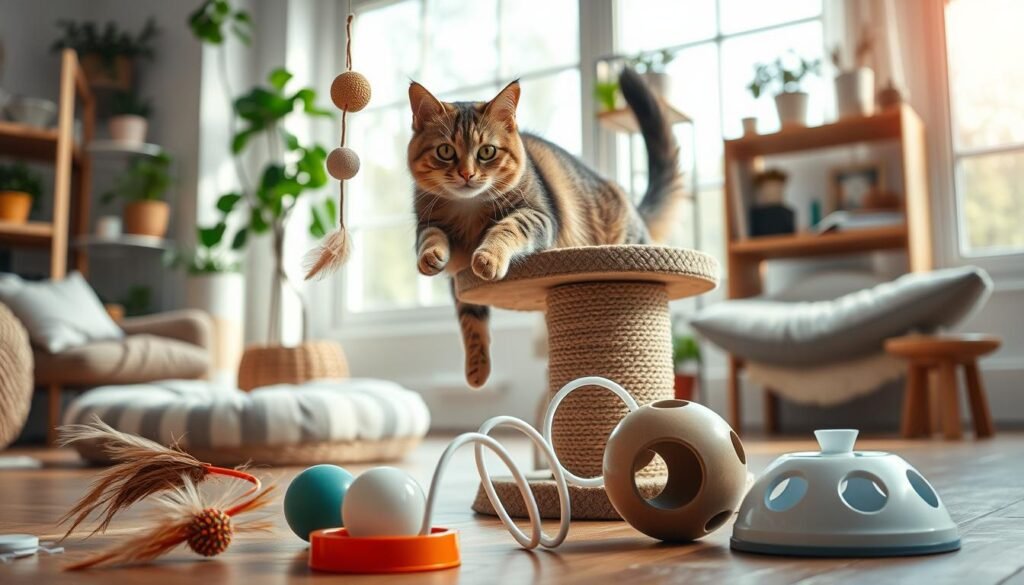
Not all toys are created equal when it comes to calming anxious cats. I’ve tested many and found some work better than others. The right toy depends on your cat’s personality and energy level.
Wand toys are my top pick for most anxious cats. The Cat Dancer and Da Bird mimic prey movements, engaging even nervous cats. Feather wands are best for timid cats, as they trigger the chase instinct without overwhelming them.
For high-energy cats, mix wand toys with catnip-filled kick toys. The Yeowww! Banana or Kong Kickeroo lets cats “kill” their prey. This satisfies their natural instincts.
Laser pointers can be useful, but use them carefully. Always end laser play with a toy your cat can catch. This prevents frustration from never catching the “prey.”
Puzzle feeders are also great for anxious cats. The Trixie 5-in-1 Activity Center and Catit Senses 2.0 Food Tree turn meals into hunting exercises. They help reduce anxiety-driven overeating.
| Toy Type | Best For | Anxiety Benefit | Recommended Product |
|---|---|---|---|
| Feather Wands | Timid, nervous cats | Builds confidence through successful “hunts” | Da Bird Original Feather Teaser |
| Laser Pointers | High-energy anxious cats | Burns excess energy quickly | PetSafe Bolt Automatic Laser |
| Kick Toys | Aggressive or frustrated cats | Satisfies “kill” instinct safely | Yeowww! Catnip Banana |
| Puzzle Feeders | Food-motivated anxious cats | Slows eating, engages problem-solving | Catit Senses 2.0 Food Tree |
Technology-Enhanced Play Options
Busy schedules can make play challenging. Smart toys and apps are great supplements to hands-on play. They provide enrichment when you’re not around.
The PetCube Play 2 is a standout remote-play device. It lets you control a laser, watch your cat, and dispense treats. It’s perfect for working cat parents who want to play with their cats during the day.
The Cheerble Smart Interactive Cat Ball offers 10-minute play sessions all day. Its obstacle-avoidance technology keeps it moving in cluttered spaces. It’s great for cats who get anxious when left alone.
Tablet apps like Cat Fishing and Game for Cats turn your iPad into a playground. They show moving fish or mice that respond to touch. These apps are useful for short distraction sessions during stressful times.
For more on these smart toys and play techniques, visit petzvibes.com. They’ve helped me refine my recommendations.
Creating Consistency That Actually Works
Consistency is key in calming anxious cats through play. The AAFP found that cats with fixed schedules are 40% less stressed. This changed how I approach play therapy.
Play before meals whenever you can. This mimics the natural hunt-catch-eat cycle. It feels instinctively right and promotes calmness.
Have two daily play sessions: one in the morning and one in the evening. These times align with cats’ natural activity peaks. Even 10 minutes per session can reduce anxiety if you stick to the schedule.
Use technology to keep your routine. I set reminders for “Luna’s morning hunt” instead of generic “play with cat.” This personal touch helps me stay committed. Apps like Streaks or Habitica make routine-building fun, even on tired days.
Track your sessions for the first month. I use a simple checklist:
- Morning play session completed (10-15 minutes)
- Evening play session completed (10-15 minutes)
- Cat successfully “caught” toy multiple times
- Play ended with feeding or treat
- Notable anxiety behaviors observed (or absence of them)
This tracking helps you stay accountable and identify patterns in your cat’s anxiety. You’ll see which toys work best and when stress is lowest.
Remember, 20 minutes of play can calm 68% of anxious cats. You’re not just playing—you’re giving them powerful medicine. This mindset helps me stay consistent, even when busy.
Understanding your cat’s needs, choosing the right toys, using smart technology, and sticking to a schedule is a winning formula. I’ve seen it transform anxious cats into confident, calm companions. You can do it too.
Gentle Touch Techniques Backed by Veterinary Science
Learning about therapeutic touch for cats changed how I interact with them. A 2020 study found that gentle petting reduced stress in 67% of cats. This is true when petting the head and neck, where scent glands are plentiful.
But, 33% of cats didn’t like being touched. This shows that touch isn’t for every cat. It’s important to respect each cat’s preferences.
For touch to be effective, cats need to feel safe and in control. I let my cats decide when to be touched. This builds trust and reduces resistance.
The Tellington TTouch Method Explained
Linda Tellington-Jones created the TTouch method. It activates the parasympathetic nervous system with circular touches. It’s a favorite of mine for calming anxious cats.
TTouch increases body awareness and stops stress patterns. It’s different from regular petting because it’s intentional and calming.
Here are three basic TTouch techniques to start with:
- Clouded Leopard Touch: Use your fingertips for small circles on your cat’s body. Do one and a quarter circles, then move to a new spot. Use light pressure, like on a ripe tomato.
- Ear TTouch: Slide your fingers from the ear base to the tip smoothly. This calms cats and they often relax right away.
- Lying Leopard Touch: Place your flat hand on your cat and make circular motions with your palm. This is less intrusive but comforting.
Start with 3-5 minutes per session. I do these techniques when my cats are relaxed, like after eating or during their favorite time.
If your cat doesn’t like hand contact, try a soft brush. Many anxious cats prefer brushing, which can calm them like touch does.
Pressure Points and Massage for Anxious Cats
Massaging specific points on a cat’s body can relax them. These techniques can help anxious cats at home.
I focus on these calming areas during massage:
- Temples: Use gentle circular motions on the area between the eyes and ears. This spot holds tension in anxious cats.
- Base of ears: Massage in small circles where the ears meet the head. This area has many nerve endings that respond to gentle pressure.
- Between the eyes: Stroke upward from between the eyes to the forehead. Many cats find this soothing.
- Chin and cheeks: Rubbing these areas, which have scent glands, feels natural and comforting to cats.
- Between shoulder blades: Apply gentle pressure with flat fingers in circular motions. This mimics a mother cat grooming her kittens.
The right technique is gentle circular motions without pressing hard. Spend 30-60 seconds on each point, watching your cat’s reactions.
Ideal massage sessions last 5-10 minutes. Short, frequent sessions work better than long ones for building trust.
Try these techniques daily—before feeding or bedtime. Consistency helps anxious cats learn to welcome the calming touch.
Reading Body Language to Know When Touch Helps
Understanding feline body language is key for safe touch therapy. Knowing when to stop is as important as knowing when to continue.
Cats show their comfort levels through physical signals. Recognizing these signs helps avoid unnecessary stress for both you and your cat.
Here’s a comparison of stress signals versus relaxation signals:
| Body Part | Stress Signals (Stop) | Relaxation Signals (Continue) |
|---|---|---|
| Eyes | Dilated pupils, rapid blinking, staring intensely | Soft eyes, slow blinks, half-closed eyelids |
| Ears | Flattened against head, rotated backward, twitching | Forward or relaxed position, gentle movements |
| Whiskers | Pulled back tightly against face | Relaxed, pointing slightly forward |
| Tail | Held close to body, tucked under, thrashing or thumping | Held loosely, gentle swaying, wrapped around you |
| Body Posture | Hunched, stiff, crouched low, muscles tense | Relaxed muscles, lying on side, exposed belly, kneading |
Watch for stress signals like nose licking, skin rippling, and sudden stiffness. If you see these, stop and give your cat space.
Positive responses include purring, head butts, kneading, and leaning into touch. These signs mean the calming techniques are working.
Remember, anxious cats rarely feel comfortable lying on their backs. An exposed belly doesn’t always mean they’re ready for touch—watch for other signs first.
Use apps like Evernote or OneNote to track your cat’s responses. This helps you refine your approach over time.
Building trust through touch takes patience. Some cats need weeks or months. Be consistent, respect their boundaries, and celebrate small victories.
For video tutorials and more guidance on soothing stressed cats at home, visit petzvibes.com. I share visual tutorials to make learning these methods easier.
Establishing Routines That Reduce Uncertainty
Working with anxious cats, I found simple daily routines make a big difference. It’s not about expensive products but how you structure your day.
Cats love routine and find comfort in knowing what’s next. When their day is predictable, they can relax instead of always being on alert.
The American Association of Feline Practitioners found that cats with fixed schedules show 40% fewer stress behaviors. This includes less vocalization and hiding.
Why Predictability Calms the Feline Brain
Understanding why routine works is key. Cats evolved as solitary hunters needing to control their territory for survival.
Their brains are wired to watch for threats. Every change triggers stress because, in the wild, it meant danger.
With predictable routines, you tell your cat’s brain it’s safe. This lowers cognitive load—the mental effort needed to deal with uncertainty.
Instead of worrying about when food comes or if something scary will happen, your cat can relax. Less worry means less anxiety and more calm.
A 2023 University of Missouri study showed a surprising benefit. Owners of calm cats reported 30% lower stress levels themselves. Routines that soothe cats also help their owners.
Creating Consistent Feeding and Play Schedules
Reducing anxiety starts with feeding and play routines. Pick times that fit your daily life.
For feeding, try these times:
- Morning feeding: 7:00 AM before you leave for work
- Evening feeding: 6:00 PM after you return home
- Optional third feeding: 10:00 PM for cats needing small meals
Play sessions should match your cat’s natural energy peaks. Most cats are active in the morning and evening, like their wild ancestors.
Here’s a play routine for soothing stressed cats:
- Morning session: 15 minutes of play before breakfast
- Evening session: 20-30 minutes of play before dinner
- Bedtime wind-down: 10 minutes of gentle play before bed
If your home lacks structure, start small. Gradual changes work better and cause less stress.
Begin with consistent feeding times for a week. Once that’s a habit, add play sessions. In three to four weeks, you’ll have a natural routine.
When you must change your schedule, plan ahead. Keep as much routine as possible. If feeding is delayed, keep play times the same. This helps reduce anxiety.
I used phone alarms to remember routines until they became automatic. After six weeks, I no longer needed them.
Using Pet Care Apps to Track and Maintain Routines
Technology helps busy cat owners stay consistent. Pet care apps offer reminders, tracking, and scheduling tools for anxiety relief.
I’ve tested many apps to find the best. Here’s a comparison of the top ones:
| App Name | Best Feature | Cost | Anxiety Tracking |
|---|---|---|---|
| 11pets | Comprehensive health and behavior logs with medication reminders | Free (premium $2.99/month) | Excellent behavior tracking with notes and photos |
| Pet Care by Appxy | Simple interface with feeding and play reminders | Free with ads (ad-free $1.99) | Basic behavior logging capabilities |
| Cats 101 | Cat-specific care guides and scheduling tools | Free | Limited tracking but good educational content |
| PetDesk | Vet appointment integration and family sharing | Free | Minimal anxiety tracking but excellent for coordination |
For managing anxiety, 11pets is the best app. It logs behavioral changes, adds photos, and tracks what works.
The premium version offers unlimited entries and cloud backup. This is useful for testing different calming techniques. You can export reports for your vet or behavior consultant.
Pet Care by Appxy is simpler but effective. Its interface is easy to use, and reminders are reliable. But, it doesn’t track behavior as well as 11pets.
PetDesk is great for shared cat care. It lets everyone see the schedule and mark tasks done. This prevents confusion about who fed the cat.
Visit https://petzvibes.com for printable routine checklists. Sometimes, a physical checklist works better than digital reminders, helping establish new habits.
The power of these apps is in their reminders. Set notifications 15 minutes before feeding. This prevents the stress of rushing to feed a demanding cat.
Creating routines takes effort, but the benefits are worth it. You’re making a safe, predictable world for your cat. This is a powerful way to calm an anxious cat naturally.
Remember, consistency is key, not perfection. If you’re late with feeding, don’t give up. Just get back on schedule as soon as you can. Your cat will adjust quickly.
Behavioral Modification and Desensitization Strategies
Working with anxious cats, I’ve learned that changing their behavior isn’t about changing who they are. It’s about helping them feel better around things that scare them. These cat anxiety behavioral therapy methods take time and patience but really work. They help your cat feel less stressed in scary situations, unlike medicines that just hide the symptoms.
Two main methods—counter-conditioning and desensitization—are key. They help your cat feel better naturally through training. I’ve seen these methods turn scared cats into confident friends. I want to share how you can use them at home.
Counter-Conditioning: Changing Negative Associations
Counter-conditioning pairs something scary with something your cat loves. It changes their fear to excitement. I used this with my cat who was scared of the carrier.
First, find out what scares your cat and what they love most. For most cats, it’s special treats. The trick is to give the treat right when they see the scary thing.
For my cat’s carrier fear, I put the carrier in the living room. Every time she looked at it, I gave her treats. In three days, she started going to the carrier on her own. After two weeks, she was eating meals in it. I let her decide when to interact, never forcing her.
“Counter-conditioning changes the emotional response at a neurological level. When done correctly, the amygdala—the brain’s fear center—begins associating the trigger with reward.”
This method works for many things that scare cats, like doorbells or other pets. The idea is the same, no matter what scares them. Start when they’re a little hungry to make treats more appealing. Keep sessions short to avoid stressing them out.
Step-by-Step Gradual Desensitization Protocol
Desensitization slowly gets your cat used to scary things without freaking out. It’s a great way to calm anxious cats, but it takes a lot of patience.
I use a step-by-step plan that works for many fears. First, find out how close your cat can be to the scary thing without getting scared. Then, start with very small steps, like sounds that are almost too quiet to hear.
The steps are:
- Week 1-2: Start with the smallest scary thing for 30 seconds, three times a day. Watch for signs of stress.
- Week 3-4: If your cat doesn’t get stressed, make the scary thing a little bit scarier. Wait until they seem relaxed before moving on.
- Week 5-8: Keep making the scary thing a little scarier, adding treats to help them feel better. Keep track of how they’re doing.
- Week 9+: Practice in different places to make sure they’re not just calm in one spot.
Don’t rush this process. I learned that too fast, and my cat got worse. The AVMA says it can take 8-12 weeks for moderate anxiety, and longer for severe cases.
| Common Trigger | Starting Intensity | Progression Timeline | Success Indicators |
|---|---|---|---|
| Carrier Training | Carrier visible across room | 8-12 weeks | Cat enters voluntarily, eats inside |
| Thunder/Fireworks | Recorded sounds at 10% volume | 10-16 weeks | Relaxed body posture during sounds |
| Visitor Anxiety | Person visible through window | 12-20 weeks | Approaches visitor for treats |
| Grooming/Handling | Brief touch (1 second) followed by treat | 6-10 weeks | Purrs or relaxes during handling |
Training Apps and Tools to Track Progress
Keeping a record of your cat’s progress is key. I use apps to track each session, noting how they react. This helps me see patterns and adjust my plan as needed.
Apps like PetPro Connect and Training Game are very helpful. They let me log behavior and set reminders. PetPro Connect even has a diary to track patterns over time.
For simple tracking, I use my phone’s video app. Watching the videos helps me catch stress signals I missed. I also look at petzvibes.com for more tips and examples.
I track a few key things:
- How long and how often we practice
- How scary the thing is
- Any signs of stress (like ears back or wide eyes)
- Any positive signs (like approaching or eating)
- How long we wait before trying again
This way, I can see real progress, even when it feels small. It also helps if I need to see a professional.
When to Consult a Certified Cat Behavior Consultant
Even with the best efforts, some cats need more help than I can give. Knowing when to ask for help is important for their well-being. It’s okay to ask for help—it’s the responsible thing to do.
Look for professional help if your cat’s anxiety gets worse or if they’re aggressive. A consultant can help you understand what’s going on and how to fix it. If you’re unsure or overwhelmed, a consultant can guide you.
It’s important to find a qualified professional. Certified Cat Behavior Consultants (CCBC) have special training in cat behavior. Veterinary Behaviorists are vets who specialize in behavior and can prescribe medicine if needed. The IAABC directory can help you find someone in your area.
Getting help is easier than ever. As of April 2025, half of U.S. vet clinics offer virtual consultations. This is great for anxious cats who don’t like going to the vet. Virtual consultations let experts see your cat in their own space, which can be more accurate.
The AVMA says about 15% of anxious cats might need medicine to help them train. This doesn’t mean behavioral methods don’t work—it just means some cats need extra help. A professional can help decide if your cat needs medicine and work with your vet.
For help, check the IAABC consultant directory, the AVSAB website, or ask your vet. Always check if they’re qualified and have experience with cat anxiety before you meet.
Monitoring Your Cat’s Progress with Modern Technology
Using technology with old-school watching gives a full view of your cat’s anxiety journey. It’s key to track changes when using natural anxiety remedies for cats. Many anxiety behaviors happen when we’re away, making it hard to see if our efforts are working.
Modern pet monitoring tools have changed how we check progress. These tools document behaviors clearly, showing patterns we can’t see by just looking.
Looking at footage from week one to week four shows small but real improvements. These changes prove that your calming techniques for feline anxiety are making a difference.
Apps and Cameras That Track Anxiety Behaviors
Pet camera apps give you 24-hour access to your cat’s behavior patterns. I’ve tested many, and some features are more important for tracking anxiety.
Video quality is at the top of my list. You need clear footage to see body language details like ear positions and tail movements. Look for cameras with at least 1080p resolution.
Two-way audio turns cameras into tools for comfort. I’ve calmed my anxious cat during thunderstorms by speaking through the camera app. Hearing your voice can really help with separation anxiety.
Motion alerts show activity patterns throughout the day. Is your cat pacing at 3 AM? Hiding when the mail carrier arrives? These alerts help create a timeline of anxiety triggers.
Night vision is important because many anxious cats are more active at night. Full spectrum monitoring shows the whole picture of their behavior.
Budget-friendly options like Wyze Cam offer great features at low prices. The Wyze Cam v3 has 1080p video, color night vision, two-way audio, and motion detection for under $40. I’ve used these in multiple rooms.
The Yi Home Camera is another good mid-range choice. It has excellent video quality and includes activity zones. You can set alerts for specific areas where your cat hides during stress episodes.
Petcube Cam vs. Furbo Cat Camera for Behavior Monitoring
After months of testing, I have strong opinions on which camera is best for anxious cat parents. Both go beyond basic monitoring, but they interact with pets differently.
Petcube Cam impressed me with its laser toy feature. This feature is great for redirecting anxious energy into play, even when you’re away. The 1080p HD video and 160-degree wide-angle view are also excellent.
The sound and motion alerts on Petcube are reliable. I also like the app’s ability to save video clips for later review. This is helpful for tracking progress over weeks.
Furbo Cat Camera takes a different approach with its treat-tossing feature. Originally for dogs, it works well for food-motivated cats. It helps create positive associations with your absence, reducing separation anxiety.
Furbo’s person detection alerts you when someone enters your home. This is useful if visitor anxiety troubles your cat. The barking alerts also adapt well for detecting excessive cat vocalizations.
| Feature | Petcube Cam | Furbo Cat Camera |
|---|---|---|
| Price Range | $199-249 | $169-199 |
| Video Quality | 1080p HD, 160° view | 1080p HD, 160° view |
| Interactive Feature | Built-in laser toy | Treat tossing mechanism |
| Two-Way Audio | Yes, with noise cancellation | Yes, standard quality |
| Special Alerts | Sound and motion alerts | Person detection, bark alerts |
| Subscription Required | Optional ($5/month for video history) | Optional ($6.99/month for features) |
| Best For | Play-responsive anxious cats | Food-motivated anxious cats |
I recommend Petcube for cats whose anxiety responds well to play therapy. The laser feature provides immediate distraction during stress episodes. Choose Furbo if your cat responds better to food rewards and you’re working on positive reinforcement protocols.
Both cameras work well with how to calm an anxious cat naturally. Visit PetzVibes.com for detailed setup guides and tracking templates designed for anxiety monitoring.
Signs Your Natural Approach Is Working
Seeing progress takes patience and attention to detail. Improvement happens gradually—small changes add up over weeks, not overnight.
Reduced hiding duration often shows first. Your cat might hide during stressful moments, but they emerge faster than before. Use your camera footage to track how long they hide.
Increased playfulness signals improving confidence. An anxious cat rediscovering their playful side shows stress levels are dropping. Note the frequency and duration of play sessions in your journal.
Appetite improvements matter a lot. Cats under stress often eat less or become pickier. When your cat returns to normal eating patterns and shows enthusiasm at mealtimes, anxiety is decreasing.
Grooming changes reveal a lot about stress levels:
- Normal grooming indicates emotional balance
- Reduced excessive grooming means anxiety is easing
- Attention to previously neglected areas shows renewed self-care
Body language shifts become obvious once you know what to watch for. Relaxed cats display soft eyes, forward-facing ears, and whiskers pointed slightly forward. Their tails remain loose and mobile, not tucked or thrashing.
Social seeking behavior is a big milestone. When your previously withdrawn cat initiates contact, requests petting, or follows you between rooms, trust is rebuilding.
Litter box habits normalize as anxiety decreases. Consistent use of the litter box without accidents indicates your cat feels secure in their environment.
Sleep patterns stabilize when cats feel safe. You’ll notice more relaxed sleeping positions—stretched out instead of tightly curled—and better sleep quality during typical rest periods.
Download progress tracking sheets from PetzVibes.com to document these improvements systematically. I use journal apps like Day One alongside video monitoring to create detailed records.
Recognizing When Professional Help Is Needed
I want to be honest with you—natural approaches work beautifully for many cats, but not every situation. Knowing when to seek professional help isn’t admitting failure. It’s responsible, loving cat care.
No improvement after 4-6 weeks of consistent intervention deserves professional evaluation. If you’ve tried multiple calming techniques for feline anxiety without any positive changes, underlying issues may need medical attention.
Worsening symptoms require immediate consultation. When anxiety behaviors intensify despite your efforts, something more serious could be developing.
Aggressive behavior toward people or other pets crosses an important threshold. While some irritability accompanies anxiety, actual aggression poses safety concerns that demand professional behavioral assessment.
Self-harm through excessive grooming creates medical emergencies. Bald patches, raw skin, or wounds from over-grooming need veterinary care immediately. The anxiety driving this behavior requires intervention beyond natural remedies.
Complete refusal to eat lasting more than 24 hours can become life-threatening. Cats develop serious liver problems when they stop eating. This always warrants emergency veterinary attention.
Persistent elimination outside the litter box—after medical causes are ruled out—often indicates severe stress. When this continues despite environmental modifications and natural calming approaches, consult a certified cat behavior consultant.
Watch for these additional red flags:
- Complete social withdrawal lasting multiple days
- Persistent hiding with refusal to emerge even for food
- Extreme vocalization that doesn’t respond to comfort
- Destructive behaviors causing property damage or self-injury
- Sudden personality changes that seem disconnected from known triggers
Many veterinarians now offer virtual consultations, making professional guidance more accessible than ever. Certified cat behavior consultants can work remotely through video calls, observing your cat’s behavior and designing customized intervention plans.
The International Association of Animal Behavior Consultants (IAABC) maintains a directory of certified professionals. Search for consultants specializing in feline anxiety who can collaborate with your veterinarian.
Remember, combining natural approaches with professional guidance often produces the best outcomes. Your veterinarian might recommend anti-anxiety medication to provide relief while natural methods take effect. This integrated approach isn’t cheating—it’s complete care.
Tracking progress with cameras and journals is invaluable during professional consultations. Showing behavior footage to your vet or consultant provides objective data that speeds up diagnosis and treatment planning.
Visit PetzVibes.com for printable behavior logs designed for veterinary consultations. These templates organize your observations in ways that help professionals assess your cat’s condition quickly.
Your dedication to learning how to calm an anxious cat naturally shows incredible commitment. Whether natural methods alone solve the problem or professional support becomes necessary, you’re giving your cat the best chance at a calmer, happier life.
Conclusion
Learning to calm an anxious cat naturally can seem tough at first. You’ve looked into many ways, like changing the environment and using pheromones. The key is to start small.
Begin with simple steps like creating safe spots and giving cats places to climb. Then, try one natural remedy at a time. See how your cat reacts and keep track of what works best.
Studies show that 82% of cats like pheromones, and 68% get better with play. These methods help most cats when used regularly.
A 2023 study from the University of Missouri found something amazing. Cats that were calm made their owners 30% less stressed. Helping your cat can also help you.
By April 2025, we’ll have even better tools to help cats, like smart cameras and CBD supplements. This is a great time to help your cat feel better naturally.
I’ve seen cats go from anxious to confident and loving. Your cat can change too.
For more help, visit petzvibes.com. They offer tracking sheets, videos, and support from other cat lovers. Every cat deserves to feel safe, and you can make that happen.
FAQ
How long does it take to see results when trying to calm an anxious cat naturally?
Seeing small improvements in 7-10 days is common when using pheromone diffusers like Feliway. This is what the AVMA recommends before checking if it works. Adding vertical spaces or hiding spots can help even faster, sometimes in just 2-3 days.
Behavioral techniques like counter-conditioning and desensitization take longer, usually 4-6 weeks. Play therapy can take several weeks, with a 2024 study showing 68% of cats improving with 20 minutes of play daily. Keep track of progress with a journal app or pet care app.
If you don’t see any positive changes after 6 weeks, it’s time to consult a vet or certified cat behavior consultant. Every cat is different, so be patient and consistent.
Can I use multiple calming methods together, or will that overwhelm my anxious cat?
Using multiple natural anxiety-relief methods is recommended for most anxious cats. A multi-pronged approach addressing different aspects of anxiety can be more effective. Start with foundational changes like adding vertical territory and hiding spaces.
Then, add a Feliway diffuser and introduce play therapy sessions. Be cautious with supplements and never combine them without veterinary guidance. Use apps to track which combinations work best for your cat. For more information, visit https://petzvibes.com.
My cat is anxious around strangers—what’s the fastest way to help them feel comfortable with visitors?
Stranger anxiety is common, and while there’s no instant fix, a structured desensitization approach works well. Start with a Feliway Classic diffuser in your main living areas at least a week before visitors arrive. This can help create a calm environment.
When visitors come, give your cat a “safe room” with all their essentials. This allows them to retreat if overwhelmed. For desensitization, start with low-stress versions of the trigger, like having a friend walk past your window while giving treats. Gradually increase exposure over weeks.
Use a pet camera to observe your cat’s behavior when you’re not there. This process can take several weeks to months, but with patience and consistency, even fearful cats can learn to tolerate visitors.
Are natural anxiety remedies safe for kittens and senior cats, or should I only use them on adult cats?
The safety of natural anxiety remedies depends on the specific remedy. Environmental modifications like vertical spaces and hiding spots are safe for all ages. Pheromone diffusers like Feliway are also safe for kittens and seniors.
Play therapy is beneficial for all ages, but adjust the intensity based on your cat’s age. Be cautious with supplements and herbal remedies, as they may have age restrictions or contraindications. Always consult with a vet before starting any supplements. For more information, visit https://petzvibes.com.
How do I know if my cat’s anxiety is severe enough to need prescription medication instead of natural remedies?
Recognizing when natural approaches aren’t enough is key. If you’ve tried natural methods for 6-8 weeks without improvement, or if symptoms worsen, consult a vet or certified cat behaviorist. Look for red flags like aggression, self-injurious behaviors, refusal to eat, or extreme fearfulness.
About 15% of anxious cats need medication alongside behavioral modification. Medications like fluoxetine (Prozac) can be lifesavers for severely anxious cats. If unsure, consult a veterinary behaviorist for professional guidance.
What’s the difference between separation anxiety and general anxiety in cats, and do they require different treatments?
General anxiety is a persistent nervousness present regardless of your presence. Separation anxiety is triggered by your absence or impending departure. General anxiety can be addressed with a multi-pronged approach, while separation anxiety requires targeted interventions.
For general anxiety, focus on environmental enrichment, pheromone diffusers, supplements, play therapy, and routines. For separation anxiety, use gradual desensitization to departure cues, counter-conditioning, and providing extra enrichment during alone periods.
Can changing my cat’s diet help reduce anxiety, or is that just marketing hype?
Diet can support anxiety management, but it’s not a standalone solution. The research is limited compared to other interventions. Some commercial “calming” cat foods contain ingredients like L-Theanine and alpha-casozepine, which have research backing their calming properties.
Choose foods with researched ingredients at appropriate levels. Never rely on diet alone for anxiety reduction.
My cat only shows anxiety during specific situations like vet visits or car rides—do I need ongoing treatment or just something for those moments?
Situational anxiety often responds well to targeted interventions. For vet visits or car rides, use advance preparation and short-term calming aids. Start with desensitization training and use Zylkene supplements 2-3 days before the event.
Feliway spray can also help. Avoid flooding and instead focus on gradual exposure. Track progress and adjust strategies as needed.
Is it true that some cat breeds are naturally more anxious than others, and does that change how I should approach treatment?
Yes, breed tendencies exist, but individual personality matters more. Siamese, Burmese, and Oriental breeds tend to be more sensitive and prone to anxiety. Understand breed tendencies to tailor your approach.
For high-striving breeds, emphasize vigorous play therapy and enrichment. For velcro breeds, focus on gradual desensitization to alone time. For reserved breeds, respect their space and avoid forced socialization.
Can I use essential oils or aromatherapy to calm my anxious cat naturally?
No, I strongly advise against using essential oils or conventional aromatherapy with cats. Cats are uniquely vulnerable to essential oil toxicity due to their liver physiology. Avoid all essential oils around cats.
Instead, use synthetic pheromone products like Feliway, which are safe and scientifically tested. For calming scents, use cat-specific plants like catnip, silver vine, and valerian root.
How do I reduce my cat’s anxiety about other pets in the household, and when introducing a new cat or dog?
Getting introductions right is key for multi-pet households. Start with slow, gradual exposure, not just putting animals together. Use a structured protocol for cat-to-cat introductions, including separation, scent exchange, and supervised interactions.
For cat-to-dog introductions, be even more cautious. Use leashes, teach commands, and provide separate spaces. Some cats may never become best friends, but peaceful coexistence is acceptable.